Brihadeeswara Temple
Thanjai Periya Kovil
Thanjavur, Tamil Nadu, India

 Nearby Airport: Tiruchirappalli International Airport (TRZ)
 Nearby Railway Station: Thanjavur Junction (TJ)
 Nearby Bus Station:
Thanjavur Old Bus Stand
Nearby Bus Station:
Thanjavur Old Bus Stand
Description:
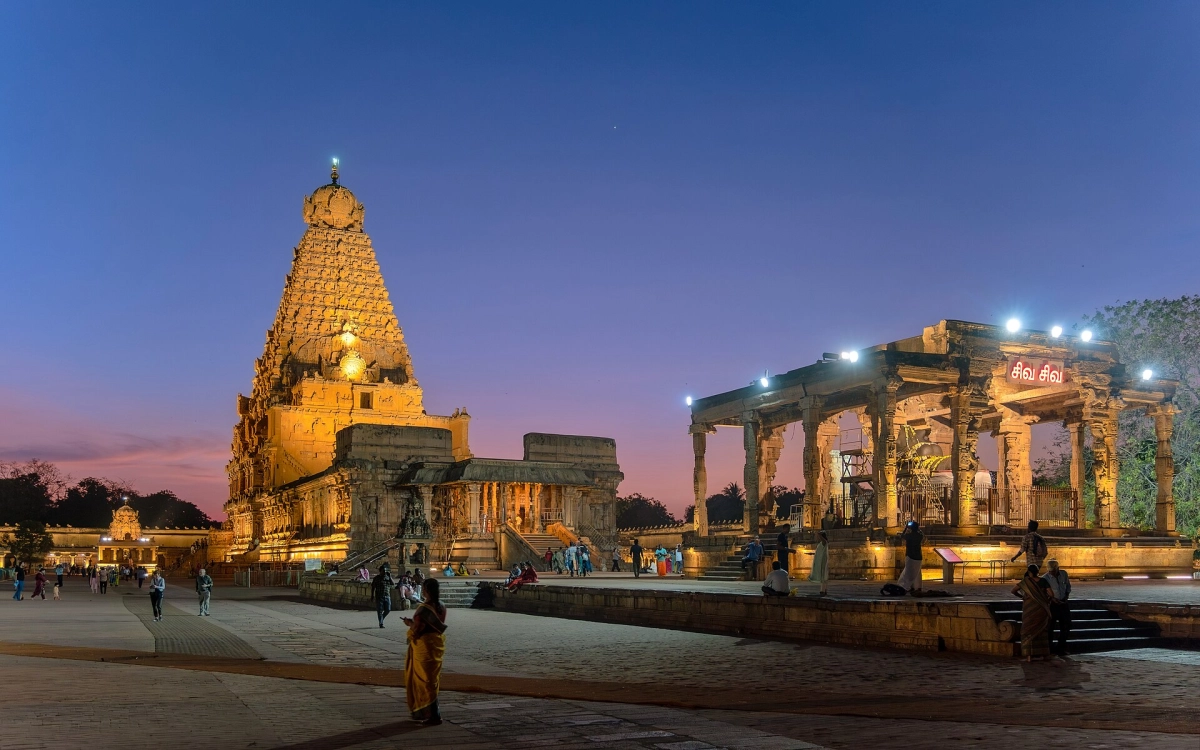
The Brihadisvara Temple (also known as the Rajarajeshvara Temple or Peruvudaiyar Kovil) is one of the most magnificent and celebrated examples of Dravidian architecture. Located in Thanjavur, Tamil Nadu, India, it was built by the great Chola emperor Rajaraja I between 1003 and 1010 CE. It is dedicated to the Hindu god Shiva and is a UNESCO World Heritage site, forming a part of the "Great Living Chola Temples."
Here is a detailed description of its key features:
1. The Colossal Vimana (Main Tower)
The most defining and awe-inspiring feature of the Brihadisvara Temple is its central tower, the Vimana, which rises directly over the garbhagriha (inner sanctum).
Height: It towers at an astonishing 216 feet (66 meters), making it one of the tallest structures of its kind in the world. Its sheer scale was unprecedented at the time of its construction.
Structure: It is a stepped, pyramidal structure consisting of 13 tiers, culminating in a square block. Unlike many later South Indian temples where the entrance gopurams are the tallest structures, here, the Vimana dominates the skyline.
The Kumbam (Capstone): Resting at the very top is a massive, monolithic cupola or dome-shaped block called the kumbam or shikhara. It is carved from a single piece of granite and is estimated to weigh around 80 tons. How this massive stone was hoisted to such a height remains a subject of architectural marvel and debate (often believed to have been achieved via a massive earthen ramp).
2. The Grand Courtyard and Layout
The temple is set within a massive rectangular courtyard, measuring roughly 240 by 120 meters.
Fortified Walls: The complex is surrounded by fortified, thick walls, reflecting the martial strength of the Chola empire.
Axial Alignment: The entire temple complex is laid out on a perfect east-west axis. Devotees pass through monumental gateways to reach the main shrines.
Spaciousness: The vast open spaces in the courtyard emphasize the towering presence of the main central structure.
3. The Nandi Mandapa
As you approach the main temple, you encounter the Nandi Mandapa, a pavilion housing the sacred bull mount of Shiva.
Monolithic Nandi: Inside sits a colossal statue of Nandi, carved from a single piece of stone. It is one of the largest Nandi statues in India, measuring approximately 12 feet high, 19.5 feet long, and nearly 8.5 feet wide.
Detailed Carving: Despite its massive size, the Nandi is intricately carved, adorned with ornaments and bells.
4. Intricate Carvings and Sculptures
The exterior walls of the temple are not just structural; they are a canvas of exquisite Chola art.
Deities and Mythology: The lower sections of the Vimana are heavily decorated with niches containing sculptures of various deities, particularly different manifestations of Shiva (like Dakshinamurthy, Nataraja, and Harihara).
Inscriptions: The temple acts as a stone archive. Extensive Tamil inscriptions ordered by King Rajaraja I cover the walls. These inscriptions meticulously detail the temple's construction, the king's conquests, the administrative details of the temple, lists of gifts (gold, jewels, land) made to the deity, and even the names of the temple dancers and staff.
Frescoes: The inner walls of the sanctum's circumambulatory path originally featured magnificent Chola-era frescoes (paintings), depicting stories from Shaivite mythology. Some of these have been preserved and restored.
5. Material and Engineering Marvel
The construction of the Brihadisvara Temple is a testament to the engineering genius of the Chola period.
All Granite Construction: The entire structure is built almost entirely of granite. This is particularly remarkable because granite is extremely hard to carve, and there are no natural granite quarries in the immediate vicinity of Thanjavur. It is estimated that over 130,000 tons of granite were transported to the site.
Interlocking Stones: The massive stones used in the construction were often fitted together using an interlocking system, without the use of mortar. The precision of the stonework is what has allowed the temple to withstand centuries of weathering and earthquakes.
Summary
The Brihadisvara Temple is not just a place of worship; it was a symbol of Chola imperial power and wealth. Its towering Vimana, the massive monolithic Kumbam, the extensive inscriptions, and the sheer volume of granite used make it a pinnacle of ancient Indian architectural and engineering achievement. It remains a powerful expression of devotion and the artistic zenith of the Chola dynasty.