
Heritage · Faith · Tradition
About the Temple
Introduction: BAPS and the Neasden Mandir
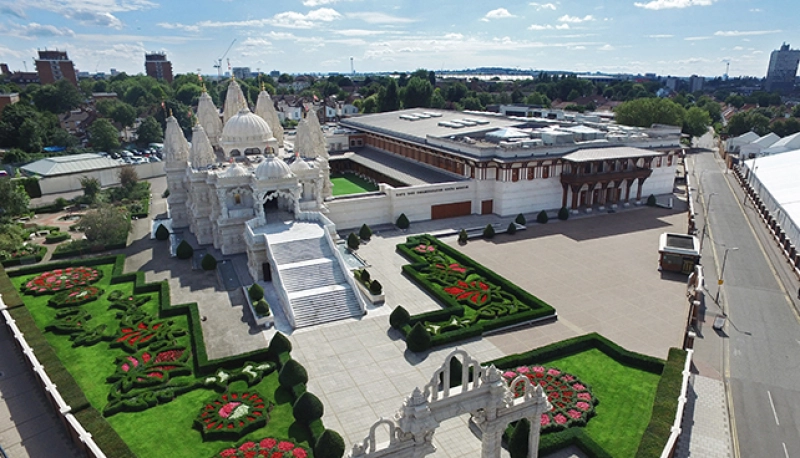
Standing in the suburb of Neasden in north-west London, the BAPS Shri Swaminarayan Mandir is one of the most remarkable religious buildings ever built in the Western world. Londoners commonly call it the "Neasden Temple". It holds the historic distinction of being the first and largest traditional Hindu stone mandir built in Europe – not a converted older building, but a mandir purpose-built and consecrated according to the principles of the ancient Hindu architectural texts.
The mandir belongs to BAPS – the Bochasanwasi Akshar Purushottam Swaminarayan Sanstha – a worldwide Hindu spiritual and humanitarian organisation rooted in the Swaminarayan tradition. BAPS was formally founded in 1907 and today runs more than 1,300 mandirs around the world. Its spiritual philosophy is Akshar-Purushottam Upasana: the belief that Bhagwan Swaminarayan (Purushottam, the Supreme God) remains ever present on earth through the living Akshar (the ideal devotee), and that moksha is attained through devotion to both.
History and the Vision of Pramukh Swami Maharaj
BAPS established its presence in the United Kingdom in June 1970, when it set up a small place of worship in a former church building in Islington, north London. As the community grew, it moved in 1982 to a former warehouse in Neasden. But the dream of the community – and above all of His Holiness Pramukh Swami Maharaj, the fifth spiritual successor of Bhagwan Swaminarayan – was to build a true, hand-carved, traditional shikharbaddha mandir on British soil.
With the blessings of Pramukh Swami Maharaj, planning began in 1990. Permission was granted in August 1992 and the foundation stone was laid in November 1992. Pramukh Swami Maharaj inaugurated the mandir on 20 August 1995 – completed in less than two and a half years from the start of the main construction, a remarkable achievement given the complexity of the project.
Construction: A Great Feat of Faith and Craftsmanship
The building of the Neasden Mandir is a story of devotion, discipline and extraordinary skill. No steel, iron or concrete at all was used in the traditional stone structure of the mandir – just as in the ancient temples of India, it is held up only by the interlocking of carved stone pieces and the force of gravity.
2,828 tonnes of Bulgarian limestone were used for the exterior, and 2,000 tonnes of Italian Carrara marble, together with Ambaji marble from Gujarat, for the interior decoration. The stone was quarried and sent to India, where the real transformation was to take place.
At 14 workshop sites in Gujarat and Rajasthan, including Ambaji, Pindwara and Dungarpur, 1,526 master craftsmen used centuries-old traditional methods to carve the limestone and marble into 26,300 individual pieces. Every piece is unique, and together they carry more than 500 distinct design patterns and 55 different ceiling designs.
All 26,300 carved pieces were shipped to London by sea in about 40 consignments – not a single piece was lost, broken or delayed. In London, more than 1,000 BAPS volunteers worked alongside the master craftsmen to assemble the mandir. The whole project cost about £12 million.
The adjoining Haveli is made of English oak and Burmese teak – 226 mature oak trees were used – and more than 150 craftsmen completed its 17,000 square feet of woodwork in under two years.
Architectural Style: Shikharbaddha
The Neasden Mandir is built in the shikharbaddha (Nagara) style of North Indian temple architecture.
- Height: 21 metres (70 feet)
- Length: 60 metres (195 feet)
- Site: 1.5 acres
- 7 shikharas (pinnacles), each crowned with a golden flower
- 6 gummats (domes)
- 193 pillars, all ornately carved
- 32 gavakshas (decorative arched windows)
- 4 jharokhas (decorative balconies)
- 26,300 hand-carved stone pieces
- More than 500 distinct design patterns
- 55 different ceiling designs
The central dome is 10 metres high. The whole structure – especially when seen against the backdrop of a London suburban street – is breathtakingly beautiful, and there is nothing quite like it anywhere else in Europe. No iron or steel has been used anywhere in the traditional stone structure.
Deities Enshrined in the Mandir
Each of the mandir's seven shikharas has its own sanctum beneath it. The main murtis are:
- Bhagwan Swaminarayan – the central deity of the BAPS faith, worshipped as the Supreme God
- Gunatitanand Swami and Gopalanand Swami – revered saints of the Akshar-Purushottam tradition
- Radha-Krishna – the divine couple, symbol of love and devotion
- Sita-Rama – the ideal of dharma and devotion
- Shiva-Parvati – the cosmic couple, symbolising auspiciousness and divine union
- Ganesh – the remover of obstacles, worshipped before every undertaking
- Hanuman – the embodiment of devotion, strength and selfless service
The Cultural Complex: Mandir and Haveli
The Neasden Mandir complex includes the stone mandir and the adjoining Haveli – a large community and cultural hall used for festivals, assemblies, community events and charitable activities. The complex also has a restaurant serving traditional vegetarian food, a gift shop and a spacious courtyard. The mandir welcomes visitors of all backgrounds and faiths.
The "Understanding Hinduism" Exhibition
One of the best-known features of the complex is the permanent "Understanding Hinduism" exhibition on the lower floor of the Haveli. Spread over more than 3,000 square feet, it includes:
- Life-size 3D dioramas depicting scenes from Hindu scripture and history
- Traditional paintings, scenes and artistic installations
- Interactive displays exploring Hindu values, philosophy and daily life
- An 11-minute documentary film giving an overview of Hinduism and BAPS
The exhibition is widely regarded as one of the best introductions to Hinduism available anywhere in the English-speaking world. A small entry fee applies.
Recognition, Records and Royal Visits
- Guinness World Records 2000: recognised as the largest traditional Hindu mandir built outside India
- Guinness World Record: 1,247 vegetarian dishes offered at the Annakut festival (27 October 2000)
- Featured among Time Out's "Seven Wonders of London"
- Included in Reader's Digest's "70 Wonders of the Modern World" (1998)
- Published as a "London landmark" in National Geographic (September 2000)
- Most Enhanced Building award (1996); Natural Stone Award (1995); UK Pride of Place Award (2007)
King Charles III (then the Prince of Wales) first visited the mandir in 1996 and returned in 2009. In October 2025, King Charles III and Queen Camilla visited to mark the mandir's 30th anniversary, joining the community for Diwali and the Hindu New Year.
BAPS: A Worldwide Spiritual and Humanitarian Organisation
Formally founded in 1907, BAPS today runs more than 1,300 mandirs, including 44 shikharbaddha (traditionally built) mandirs, and is active in more than 40 countries.
Its fifth leader, His Holiness Pramukh Swami Maharaj, led the organisation for more than five decades and built hundreds of mandirs – including the Neasden Mandir and the famous Akshardham complex in New Delhi. He passed away on 13 August 2016. Mahant Swami Maharaj now leads BAPS worldwide.
Beyond building mandirs, BAPS is deeply involved in disaster relief, blood donation camps, anti-addiction campaigns, environmental initiatives and educational programmes.
Visitor Information
Address: 105-119 Brentfield Road, Neasden, London NW10 8LD (also known as Pramukh Swami Road)
Opening hours: 9:00 AM to 6:00 PM daily, including bank holidays.
Entry: entry to the mandir is free. A small fee applies for the Understanding Hinduism exhibition (£2 for adults, £1.50 concessions).
Dress code: modest clothing that covers the shoulders, chest and midriff is required. Shoes must be removed before entering the mandir; shoe storage is available.
How to Reach
- Underground – Stonebridge Park (Bakerloo line): take bus 112; about a 9-minute walk from the bus stop.
- Underground – Wembley Park (Metropolitan and Jubilee lines): take bus 206 towards Kilburn Park and get off on Brentfield Road.
- Underground – Neasden (Jubilee line): about a 20-minute walk via Neasden Lane.
- Bus: routes 206 and 224 stop on Brentfield Road outside the mandir; route 112 also serves the area.
- By car: from the M1 (Junction 1) or the M4 (Junction 1), follow the A406 North Circular Road and turn into Brentfield Road. Parking for 550 cars is available.
The mandir is about 6 miles north-west of central London and attracts more than 100,000 visitors from around the world every year.