
Heritage · Faith · Tradition
About the Temple
Introduction
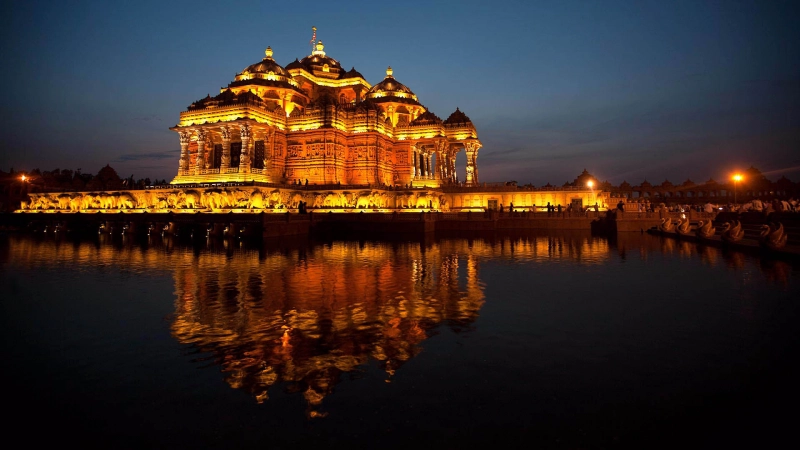
Swaminarayan Akshardham in New Delhi is one of the largest and most magnificent Hindu temple complexes in the world. Standing on the banks of the Yamuna river in East Delhi, it was built by BAPS (Bochasanwasi Akshar Purushottam Swaminarayan Sanstha) and opened to the public in November 2005. Akshardham is at once a place of worship, a celebration of India's art and culture, and a centre for learning about timeless spiritual values. In 2007 it was recognised by Guinness World Records as the world's largest comprehensive Hindu temple.
Main Deity and Worship
The central mandir is dedicated to Bhagwan Swaminarayan (1781–1830), revered by his followers as the supreme manifestation of God. Under the central dome stands a striking, gold-finished murti of Bhagwan Swaminarayan, surrounded by murtis of the great spiritual successors of his tradition. The mandir also honours other beloved forms of the Divine, including Sri Radha-Krishna, Sri Sita-Rama, Sri Lakshmi-Narayana and Sri Shiva-Parvati. Arti is offered at set times each day.
About Bhagwan Swaminarayan
Bhagwan Swaminarayan was born in 1781 at Chhapaiya, near Ayodhya in Uttar Pradesh. At the age of eleven he left home and, as the child-yogi Neelkanth Varni, walked barefoot across India for seven years – through the Himalayas, the forests of the east and the temples of the south – before settling in Gujarat. There he spent the rest of his life teaching devotion, moral living, non-violence and service to society, and he founded the Swaminarayan Sampradaya that continues today.
History of the Monument
The idea of an Akshardham on the banks of the Yamuna was a long-held wish of Yogiji Maharaj, a revered guru of the BAPS tradition. His successor, Pramukh Swami Maharaj, brought this vision to life. Construction began in 2000, and thousands of skilled artisans and volunteers worked for about five years to complete it. The complex was inaugurated on 6 November 2005.
Architecture
The main mandir is built entirely of intricately carved pink sandstone from Rajasthan and white Italian marble, following ancient Hindu architectural texts. In keeping with traditional temple-building methods, no structural steel was used. Its many domes, hundreds of carved pillars and thousands of sculpted figures depict deities, sages, devotees, musicians, dancers, animals and flowers.
Around the base of the mandir runs the Gajendra Pith, a long stone frieze of life-size elephants that pays tribute to the elephant's place in Indian culture and stories. The mandir is encircled by a two-storey colonnade (parikrama) and by the Narayan Sarovar, a sacred water body said to hold water collected from many holy rivers and lakes of India.
Exhibitions and Attractions
- Hall of Values: lifelike figures and dioramas bring to life episodes from Bhagwan Swaminarayan's life, teaching values such as non-violence, honesty and prayer.
- Giant-screen film: a large-format film follows the child-yogi Neelkanth Varni on his remarkable journey across India.
- Cultural boat ride: a gentle ride through recreations of ancient India, showing its contributions to science, medicine, art and learning over thousands of years.
- Water show: in the evening, a show of music, lights, fire and water is held at the large stepped tank (kund) on the campus.
- Gardens: landscaped lawns with bronze statues of India's great heroes, freedom fighters and noble women.
Timings and Visitor Rules
- Akshardham is generally open from morning to evening, and it is closed on Mondays.
- Entry to the complex and the mandir is free. The exhibitions and the water show require tickets.
- Mobile phones, cameras and electronic devices are not allowed inside. Cloakroom facilities are available at the entrance.
- Please check the official Akshardham website for current timings and show schedules before your visit.
Festivals
- Diwali and Annakut (October–November): the temple is beautifully decorated, and on the Hindu New Year a grand Annakut offering of hundreds of vegetarian dishes is presented to God.
- Swaminarayan Jayanti and Sri Rama Navami (March–April): the birth anniversary of Bhagwan Swaminarayan falls on the same day as Sri Rama Navami and is celebrated with special worship.
- Janmashtami (August–September): the birth of Lord Krishna is celebrated with midnight arti.
How to Reach
By Metro: The easiest way to reach the temple is by the Delhi Metro. Akshardham Metro Station on the Blue Line is just a short walk from the entrance.
By Road: The complex is on National Highway 9 (old NH 24), near the Commonwealth Games Village. Buses, autos and taxis are easily available from all parts of Delhi and the NCR.
By Train: Hazrat Nizamuddin (about 7 km) and New Delhi Railway Station (about 9 km) are the nearest major stations. Anand Vihar Terminal is also close by.
By Air: Indira Gandhi International Airport (DEL) is about 25 km away.
Visitor Information
- Dress code: modest clothing that covers the shoulders and knees is required. Cover-up sarongs are available at the entrance if needed.
- Time needed: allow at least 3–4 hours to see the mandir and the exhibitions, and stay till evening for the water show.
- Best time to visit: October to March, when Delhi's weather is pleasant. Weekdays (Tuesday to Friday) are less crowded than weekends.
- Food: a large vegetarian food court is available inside the campus.
- Nearby places: Humayun's Tomb, India Gate, the Lotus Temple, the Red Fort and the ISKCON temple at East of Kailash.