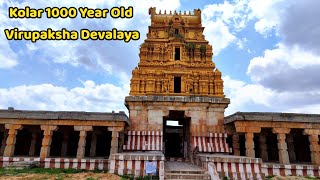
Ancient Shri Virupaksha Devalaya
Ancient Shri Virupaksha Devalaya
Virupaksha Village, Mulbagal Taluk, Karnataka State, Karnataka, India

 Nearby Airport: Kempegowda International Airport Bengaluru
 Nearby Railway Station: Mulbagal
 Nearby Bus Station:
Mulbagal
Nearby Bus Station:
Mulbagal
Description:
Introduction
Nestled in the sacred hamlet of Virupaksha Village (Virupakshapura) in Mulbagal Taluk, Kolar District, Karnataka, the Ancient Shri Virupaksha Devalaya is one of the most venerable Shaiva shrines in the eastern Deccan plateau. The presiding deity is Lord Virupaksha — a powerful, primordial form of Lord Shiva. The name Virupaksha means "He of all-seeing eyes," signifying Shiva in his cosmic, omniscient aspect. Enshrined here is an exceptionally rare Atma Linga — one of only two such lingas known in all of India, the other being at the Gokarna Mahabhaleshwara temple. The temple also bears the name Virupaksha Someshwara Devalaya, reflecting its dual Shaiva significance. Situated approximately 5 km from Mulbagal town and around 100 km east of Bengaluru on the NH-75 corridor, this temple draws pilgrims, historians, and spiritual seekers alike.
Historical Background
The origins of this sacred site are rooted in great antiquity. According to the temple's Sthalapurana, the Shivalinga here was installed by the revered sage Atri Maharishi, making this a place of penance and divine revelation long before formal construction began. The region of Kolar (ancient Kuvalalapura) passed through the Western Ganga dynasty (4th–10th century CE), Chola rulers (until 1116 CE), and the Hoysala Empire (from 1117 CE), each leaving its spiritual imprint.
The present stone temple structure is broadly dated to the early Vijayanagara period, attributed to Lakkana Dandesha, the chieftain-governor of Mulavayi (Mulbagal) under Devaraya II of the Vijayanagara Empire (r. 1424–1446 CE). The temple's importance is confirmed by a Kannada inscription dated 1481 CE found within the complex, recording the contributions of Heggadedeva — a senior Vijayanagara official — toward the compound walls, a golden Kalasha, a sacred Pushkarani (temple tank), and a Kalyana Mantapa. A priestly lineage from the Agasthya Gotra has conducted temple rituals here for eight consecutive generations, an unbroken tradition of over five centuries.
Architecture — Dravidian Grandeur in Stone
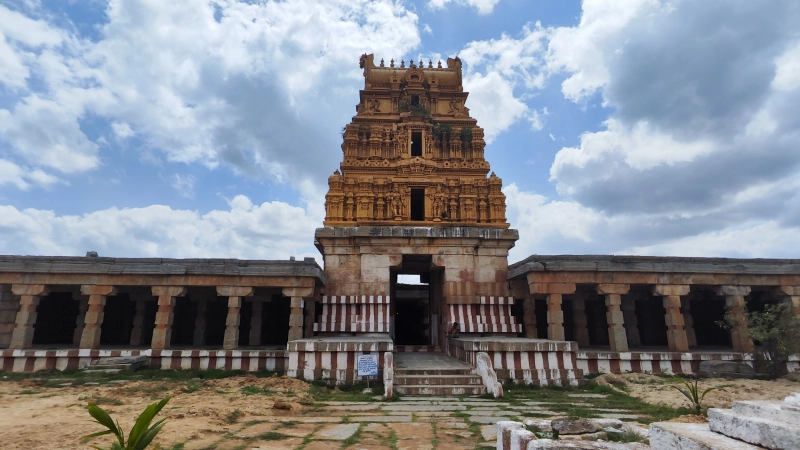
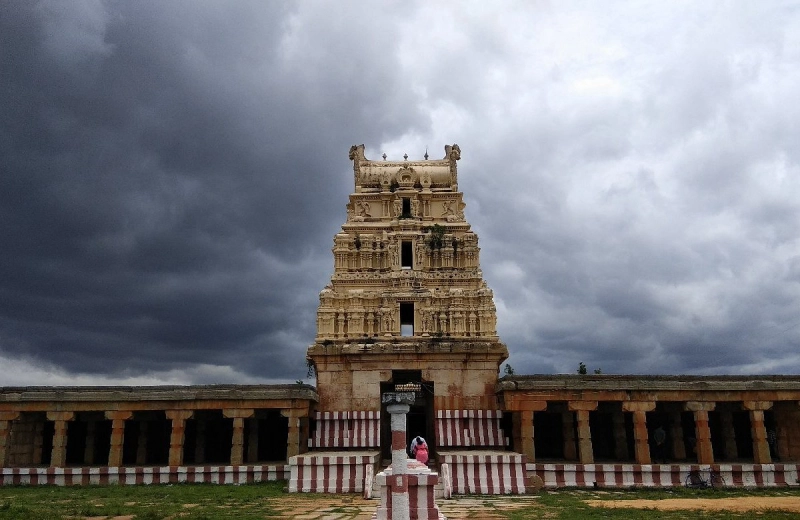
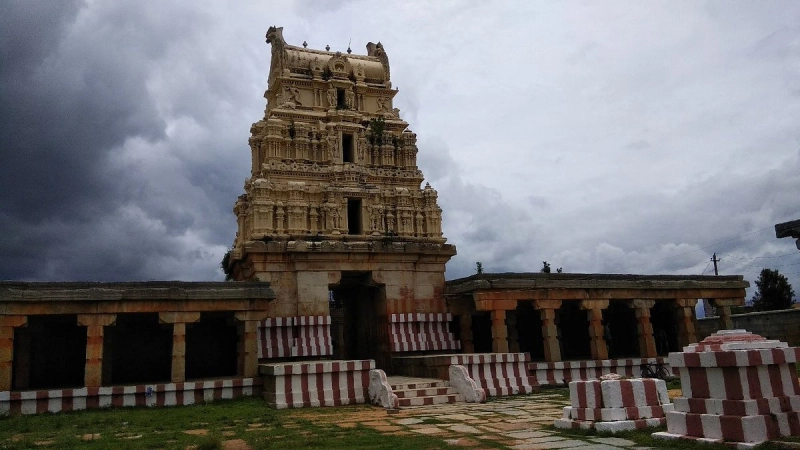
The Virupaksha Devalaya is a fine specimen of Dravidian temple architecture as refined by the Vijayanagara school of temple building. The complex is oriented east-facing and is enclosed within fortified compound walls that once formed part of a larger fort complex.
- Gopura (Gateway Tower): The main entrance features a three-tiered Rajagopuram decorated with sculpted Dwarapalas (guardian deities). An unfinished base gopuram at the primary approach suggests the complex was planned for further expansion.
- Garbhagriha (Sanctum Sanctorum): The inner sanctum houses two Shivalingas placed one behind the other on the same axis — a configuration of extreme rarity in South Indian temples, shared only with the Gokarna Mahabhaleshwara temple.
- Mandapas (Pillared Halls): The temple plan comprises two Ardhamantapas, a Navagraha Mantapa housing the nine planetary deities, and a large Mukhamantapa with finely carved pillars depicting animals, birds, floral motifs, and mythological figures.
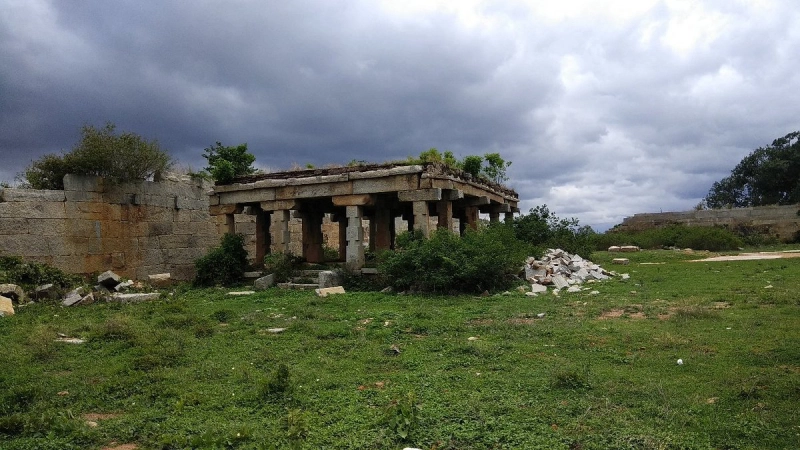
- Kalyana Mantapa (Marriage Hall): A ceremonial pavilion with elaborately sculpted pillars, used for the divine wedding (Kalyanam) of the deities, in well-preserved condition.
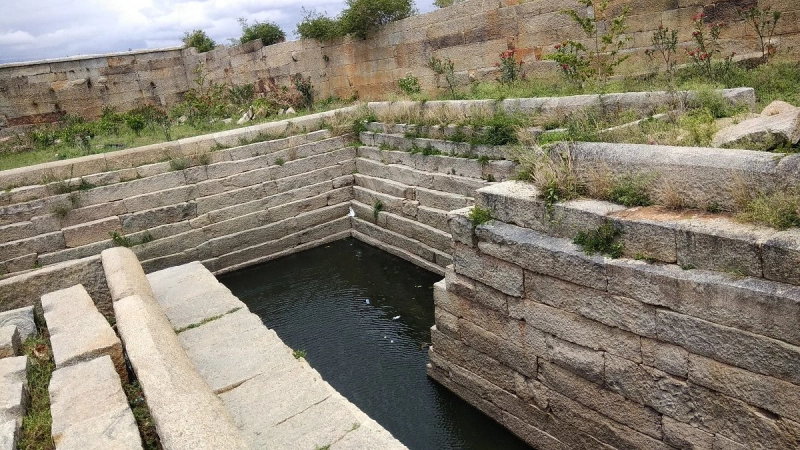
- Pushkarani (Temple Tank): A sacred stepwell within the complex, used for ritual bathing and consecration rites, still in use today.
- Fort Walls: The outer compound walls bear carved decorations of fish, birds, and human figures — decorative motifs typical of the Vijayanagara fortification style.
A unique feature of the sanctum is a small 2 × 2 foot pit in the floor directly in front of the Garbhagriha, traditionally believed to concentrate cosmic energy and considered auspicious for meditation.
Main Deity and Associated Shrines
The presiding deity is Sri Virupakshishwara (also called Virupaksha Someshwara), worshipped in the form of a Shivalinga.
- Virupaksha Atma Linga: The foremost linga, believed to be self-manifested (Svayambhu). It is renowned for a miraculous colour-changing phenomenon: deep blood-red in the early morning, milky white in the afternoon, and honey-golden in the evening — a scientifically unexplained phenomenon drawing devotees for centuries.
- Marga Darshana Ishwara Linga: The second, slightly larger linga in the same sanctum, associated with the penance of sage Atri Maharishi and considered the "guide-linga" (Marga Darshana = "one who shows the path").
- Goddess Bagalamukhi Shrine: A separate shrine dedicated to Devi Bagalamukhi (Pitambara Devi), one of the ten Mahavidyas, believed to ward off negative forces and grant victory. Tradition holds this shrine was established by King Vikramaditya.
- Devi Parvati Shrine: Located in the northwest corner of the complex, this shrine features a distinctive standing lion statue in a rare Simha Vahana posture.
- Navagraha Mandapa: A dedicated enclosure housing the nine planetary deities, allowing devotees to seek celestial blessings alongside Shaiva worship.
Religious Significance and Festivals
The temple is revered as both a Shakti Kshetra and a premier Shaiva pilgrimage site. The simultaneous presence of an Atma Linga and the Bagalamukhi Devi shrine makes it a uniquely powerful spiritual confluence.
- Maha Shivaratri: The most significant festival, celebrated with night-long vigil, Abhishekam (sacred bathing with milk, honey, and water), Panchakshara Mantra chanting, and offering of bilva leaves. Thousands of pilgrims from Kolar, Chikkaballapura, and Bengaluru converge on the temple.
- Rathotsava (Chariot Festival): Held on Rathasaptami (January–February). The deity is taken in a grand ceremonial chariot procession through the village, accompanied by music and devotional singing.
- Kartika Purnima: The full moon in Kartika month (October–November) is observed with special lamps, Deepotsava (festival of lights), and circumambulation of the temple.
- Pradosha Puja: Observed twice a month on the 13th lunar day, drawing regular devotees from surrounding villages for evening Shiva worship.
- Ugadi: The Kannada New Year is celebrated with special pujas, Annadanam (community meals), and cultural programs.
How to Reach
The temple is located in Virupaksha Village (Virupakshapura), approximately 5 km from Mulbagal town, 34 km east of Kolar city, and roughly 100 km east of Bengaluru via National Highway 75 (NH-75, Bengaluru–Chennai Highway).
- By Road from Bengaluru: Take NH-75 eastward through Hoskote to Mulbagal (approx. 100 km, 2–2.5 hours). From Mulbagal town, proceed 5 km toward Virupaksha Village. KSRTC buses run from Bengaluru's Majestic and Shivajinagar bus stands to Mulbagal. Local autos and taxis ply from Mulbagal to the temple.
- By Train: The nearest railway station is Bangarpet (approximately 45 km away), well connected to Bengaluru. Taxis and buses are available from Bangarpet to Mulbagal.
- By Air: The nearest airport is Kempegowda International Airport, Bengaluru (approximately 100 km). Hire cars and taxis are available directly to the temple.
Practical Visitor Information
- Temple Timings: Morning — 8:00 AM to 11:00 AM; Evening — 4:00 PM to 7:00 PM. Extended timings on Maha Shivaratri and major festival days.
- Entry: Free for all devotees. No entry fee.
- Dress Code: Modest traditional attire is expected. Men are encouraged to wear dhoti or full-length trousers; women are advised to wear sarees, salwar kameez, or other traditional dress. Sleeveless and short clothing is discouraged.
- Photography: Photography inside the Garbhagriha (inner sanctum) is generally not permitted. Please check with temple authorities.
- Best Time to Visit: October to February is ideal — the weather is pleasant and major festivals fall in this window. Early morning visits allow you to witness the Atma Linga in its distinctive blood-red colour — a rare and moving sight.
- Nearby Attractions: Mulbagal is home to the famous Kurudumale Ganesha Temple (2 km), Kotilingeshwara Temple at Kammasandra (30 km), and the Kaivara Bhakta Raghavendra ashram. Kolar Gold Fields (KGF) is about 30 km away.
- Accommodation: Basic lodges are available in Mulbagal town. Kolar city (30 km) offers better hotel options. Day-trippers from Bengaluru can comfortably visit and return the same day.