
Heritage · Faith · Tradition
About the Temple
About Brihadeeswara Temple
Standing on the Kaveri plains of Tamil Nadu, the Brihadeeswara Temple of Thanjavur – also called Peruvudaiyar Kovil or Rajarajeswaram – is a towering testament to human building genius. Built by the great Chola emperor Rajaraja Chola I and consecrated in 1010 CE, it has stood for more than a thousand years. In 1987 UNESCO recognised it as a World Heritage Site, and in 2004 the Gangaikonda Cholapuram and Darasuram temples were added to form the "Great Living Chola Temples". It remains a living place of worship where pujas continue every day.
The Presiding Deity: Brihadeeswara Shiva
The main deity of the temple is Lord Shiva, worshipped here as Brihadeeswara (the Great Lord), or Peruvudaiyar in Tamil. The sanctum holds a great Shivalinga about 8.7 metres (29 feet) tall – one of the largest Shivalingas in India. The Goddess is enshrined in a separate shrine as Brihannayaki (Periyanayaki). A magnificent 11th-century bronze of Nataraja is also preserved here as a supreme example of Chola art.
The Builder and History
Rajaraja Chola I (reigned 985–1014 CE), one of the greatest rulers in South Indian history, built this temple as a symbol of spiritual glory during his reign. Construction began in 1003 CE and was completed in 1010 CE. Rajaraja dedicated vast land grants, and gold and jewels won in his military victories, to the temple. More than 600 people served the temple – priests, musicians, dancers, lamp-lighters, guards, cobblers, accountants and more – and their names, duties and wages were all carved as inscriptions on the temple walls.
Architecture: The Vimana and the Shikhara
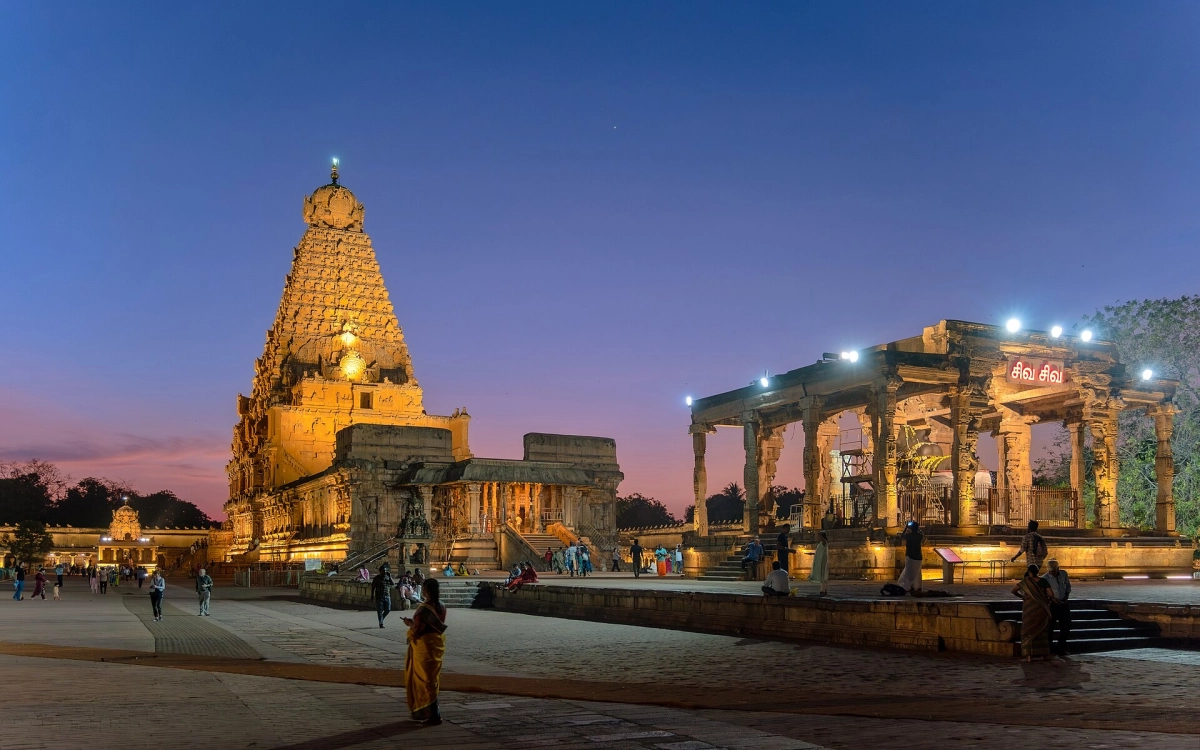
The most important structure of the temple is the vimana – a pyramid-shaped tower of thirteen storeys rising about 216 feet (nearly 66 metres). About 1,30,000 tonnes of granite were used in its construction, brought from quarries about 60 km away. Most remarkably of all, this great structure was built without any mortar, using interlocking stones that fit into one another – gravity and engineering skill are its foundation.
The shikhara (cupola) crowning the vimana is carved from a single block of granite weighing about 80 tonnes. Experts believe that a 6.44 km-long earthen ramp was built to raise it to the top. This single stone crown alone is proof of outstanding engineering skill.
There is a popular belief that "the shadow of the vimana never falls on the ground", but the truth is even more remarkable: because of the stepped design of the vimana's thirteen storeys, the tower's shadow falls mostly on its own stone layers. At midday the shadow spreads northward within the temple courtyard and does not extend beyond it. This is no accident – it reflects the brilliant solar orientation chosen by Chola engineers who understood astronomy.
The Sacred Nandi
The great Nandi in front of the sanctum is a monolith carved from a single block of granite. About 6 metres long, 3.7 metres high and 2.5 metres wide, and weighing about 25 tonnes, it is the second-largest monolithic Nandi in India. (The largest is at Lepakshi in Andhra Pradesh – 8.23 metres long and 4.5 metres high.) The Nandi is housed in a roofed pavilion called the Nandi Mandapam.
Inscriptions: History Written in Stone
The temple walls carry 64 inscriptions of Rajaraja Chola I and 29 of his son Rajendra Chola I, in Tamil and Grantha script. One inscription from 1011 CE lists the names, duties and wages of the 600 temple staff. Historians regard these as some of the most complete stone records found anywhere in medieval South Asia.
Murals: Two Centuries of Painting on One Wall
The walls of the temple's inner circumambulatory passage hide a wonderful secret. The lower layer holds 11th-century Chola-era paintings – true buon fresco, with colours applied directly onto wet lime plaster. Covering about 240 square metres, these paintings show different forms of Shiva (Nataraja, Tripurantaka, Bhikshatana, Dakshinamurthy), the life story of the Shaiva saint Sundarar, and a royal procession believed to show Rajaraja Chola himself.
Over these Chola paintings, another layer was painted in the 16th century under the Nayaka rulers – bright colours, a decorative style and mythological scenes such as the wedding of Shiva and Parvati. In 1931, a conservation expert of the Archaeological Survey of India noticed the upper layer flaking away and discovered the older paintings beneath. Even today, small "windows" opened at selected spots allow visitors to see the ancient Chola murals.
The Temple Complex: Sub-shrines, Lingams and Sacred Spaces
The temple courtyard is a vast rectangle about 240 metres long and 120 metres wide. Its main features include:
- About 250 Shivalingas placed along the outer circumambulation path; devotees can worship each one as they walk around.
- Sub-shrines for Ganesha, Murugan (Subrahmanya), Parvati (Brihannayaki), Nandi, Dakshinamurthy, Varahi, Chandeswara and the Ashta Dikpalakas.
- The Sivaganga tank to the north of the temple, where devotees bathe before going for darshan.
- The Ardha Mandapam, Mukha Mandapam and Maha Mandapam – three halls that connect the sanctum with the outer courtyard.
Festivals
- Maha Shivaratri (February–March): the most important festival, with all-night abhishekams, music concerts and the chanting of mantras. The Brihan Natyanjali international classical dance festival is held at the time of Shivaratri.
- Aippasi Brahmotsavam (October–November): a grand annual festival lasting many days, with a chariot procession and cultural programmes.
- Panguni Uthiram (March–April): the celebration of the wedding of Shiva and Parvati.
- Thai Poosam (January–February): special pujas at the Murugan (Subrahmanya) shrine.
- Aadi Amavasai (July–August): an important day for rites in honour of ancestors (pitru tarpanam), drawing large numbers of devotees.
Visitor Information
Darshan timings: open every day from 6:00 AM to 12:30 PM and from 4:00 PM to 8:30 PM. The sanctum is closed during the afternoon break for rituals. Photography is not allowed inside the inner sanctum.
How to reach: Thanjavur Junction railway station is just 1.5 km from the temple, with direct trains from Chennai Egmore (about 5 hours). The nearest airport is Tiruchirappalli International Airport (Trichy), 55–61 km away. By road, Thanjavur is about 350 km from Chennai. The temple is in the city centre near the Thanjavur Palace, and autorickshaws and taxis are easily available.
Best time to visit: November to February, when the weather is cool. It is good to arrive early in the morning, when the temple opens, to see the morning pujas.