Heritage · Faith · Tradition
About the Temple
Introduction
Sri Sharadamba Temple at Sringeri, in Chikkamagaluru district, Karnataka, is the shrine of Goddess Sharada – the Goddess of learning, wisdom and the arts, a form of Saraswati. It stands on the banks of the Tunga river in the green hills of the Western Ghats, and is the heart of the Sringeri Sharada Peetham, the first of the four great monasteries (mathas) established by Adi Shankaracharya. For more than a thousand years, Sringeri has been one of the foremost centres of Vedic learning and the Advaita tradition.
The Goddess – Sri Sharadamba
The presiding deity is Sri Sharadamba, worshipped as the Mother of all knowledge. Devotees, and especially students, come here to pray for learning, wisdom, clear speech and success in studies and the arts. The Goddess is seen in a seated form, holding symbols of knowledge, and her worship here follows the traditions laid down by the Acharyas of the Peetham.
Sthala Puranam and the Founding of the Peetham
According to tradition, Adi Shankaracharya chose Sringeri when he saw a remarkable sight on the banks of the Tunga: a cobra spreading its hood to shield a frog in labour from the scorching sun. Seeing natural enemies at peace here, he recognised Sringeri as a sacred place of harmony, and established his first monastery here, the Dakshinamnaya Sharada Peetham.
Tradition also tells that Goddess Saraswati, in the form of Ubhaya Bharati – the learned wife of the scholar Mandana Mishra – followed Shankaracharya after their famous debate, and agreed to stay at the place where he settled. She remained at Sringeri as Sharadamba. The name Sringeri itself is linked with the sage Rishyashringa, who is said to have lived in these hills.
History
The Goddess was first worshipped here in a sandalwood image installed, by tradition, by Adi Shankaracharya. In the 14th century, the great sage Sri Vidyaranya – a Jagadguru of the Peetham and a guiding spirit behind the founding of the Vijayanagara empire – installed a golden image of the Goddess. The present temple was rebuilt in the early 20th century in the South Indian style. An unbroken line of Jagadgurus, the heads of the Sringeri Sharada Peetham, continues to guide the temple and the monastery today.
The Vidyashankara Temple
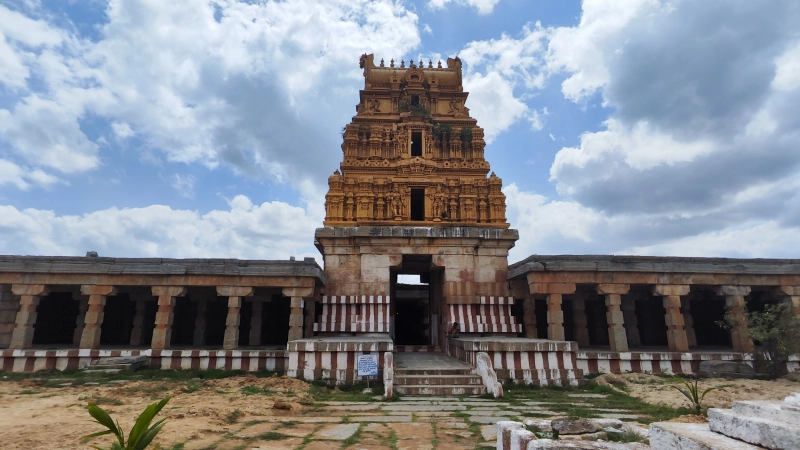
Next to the Sharadamba temple stands the Vidyashankara Temple, built in the 14th century in honour of the Jagadguru Sri Vidyashankara, with the support of the founders of the Vijayanagara empire. It is a masterpiece of early Vijayanagara-era architecture, blending Hoysala and Dravidian features. Built entirely of stone on a raised base, it is richly carved with deities, scenes from the Puranas and animals.
Its most famous feature is a set of twelve zodiac pillars in the hall, each marked with a sign of the zodiac. The temple is so precisely aligned that the rays of the rising sun fall on the pillar of the zodiac sign corresponding to the current month – a remarkable blend of art, astronomy and devotion.
Akshara Abhyasam and Worship
Sringeri is one of the most popular places in South India for Akshara Abhyasam – the ceremony in which young children write their first letters before the Goddess of learning. Families travel from far and wide for this auspicious beginning. Many devotees also receive the blessings of the Jagadguru, and the Peetham offers free meals (annadanam) to pilgrims. At the riverside steps, devotees enjoy feeding the large fish that gather in the Tunga.
Festivals
- Sharad Navaratri (September–October): the grandest festival at Sringeri, with the Goddess adorned in a different alankaram each day and special pujas led by the Jagadguru.
- Shankara Jayanti (Vaisakha, April–May): the birth anniversary of Adi Shankaracharya, celebrated with great devotion.
- Vasantha Panchami (January–February): an auspicious day for the worship of the Goddess of learning and for Akshara Abhyasam.
Temple Timings
- The temple is generally open in the morning and again in the evening, with a break in the afternoon.
- Timings change during Navaratri and other festivals. Please check with the Peetham before your visit.
How to Reach
By Road: Sringeri is about 90 km from Chikkamagaluru, about 100 km from Mangaluru and about 330 km from Bengaluru. KSRTC and private buses connect Sringeri with Mangaluru, Udupi, Shivamogga, Chikkamagaluru and Bengaluru. The final stretch runs through beautiful forested ghats.
By Train: the nearest convenient railway stations are Udupi and Shivamogga, with buses and taxis onward to Sringeri.
By Air: the nearest airport is Mangaluru International Airport (IXE), about 100 km away.
Visitor Information
- Dress code: traditional attire is expected – dhoti for men and saree or churidar with dupatta for women, especially for sevas and for meeting the Jagadguru.
- Akshara Abhyasam: enquire at the Peetham office about the ceremony and the auspicious days for it.
- Best time to visit: October to February is pleasant; the monsoon (June–September) is very green but wet.
- Nearby places: the Vidyashankara Temple, the Narasimha Vana on the other bank of the Tunga, Sri Annapoorneshwari Temple at Horanadu, Kalasa, and the hills of Kudremukh.