Heritage · Faith · Tradition
About the Temple
Introduction
The Sri Veerabhadra Swamy Temple at Lepakshi, in Sri Sathya Sai district of Andhra Pradesh, is one of the finest treasures of Vijayanagara art. Built on a low granite hill shaped like a tortoise – the Kurma Saila – it is celebrated for its hanging pillar, its brilliantly painted ceilings, a great serpent-hooded Lingam and the colossal monolithic Nandi nearby. The temple is a protected monument of national importance, and in 2022 the Veerabhadra temple and the Lepakshi Nandi were placed on India's tentative list for UNESCO World Heritage.
Main Deity
The presiding deity is Sri Veerabhadra Swamy, the fierce form that Lord Shiva created from his matted locks to end Daksha's arrogant sacrifice after the loss of Goddess Sati. Despite his fierce origin, he is worshipped here as a protector who removes fear and destroys injustice. The complex also has shrines for Shiva as Papanatheswara, for Sri Raghunatha (Vishnu) and for the Goddess as Bhadrakali.
History
The temple was built around 1530 (some sources say 1540) by the brothers Virupanna and Viranna, who served as governors at Penukonda under the Vijayanagara emperor Achyuta Deva Raya. Inscriptions at the temple record its building and the gifts made to it. A popular legend also links the name of the place with the Ramayana: when Lord Rama found the wounded bird Jatayu here, who had fought Ravana to save Sita, he is said to have told him, "Le, Pakshi" – "Rise, O bird".
Architecture and Art
Lepakshi is a textbook example of the Vijayanagara style, with carving and painting covering almost every surface:
- The hanging pillar: among the many carved pillars of the main hall, one does not fully rest on the floor – visitors famously slide a thin cloth or paper beneath it.
- Ceiling frescoes: the ceilings are covered with paintings in natural colours showing scenes from the epics and Puranas, along with portraits of the patrons. The great painting of Lord Veerabhadra on the ceiling of the ardha mandapam, about 23 by 13 feet, is counted among the largest such frescoes in Asia.
- The Nagalinga: a huge granite boulder carved into a coiled seven-hooded serpent sheltering a Shiva Lingam – one of the most striking sculptures of the complex.
- Monolithic Ganesha and many fine panels of musicians, dancers and deities.
- The Kalyana Mandapam: an open, beautifully carved wedding hall that was left unfinished, with its sculpted pillars still standing in the open air.
The Lepakshi Nandi
About 200 metres from the temple, facing the Nagalinga, sits the famous Lepakshi Nandi, carved from a single block of granite. At about 8.23 metres long and 4.5 metres high, it is regarded as the largest monolithic Nandi in India, larger even than the celebrated Nandi of the Brihadeeswara Temple, Thanjavur. Its graceful posture and finely carved bells and ornaments make it a masterpiece in its own right.
Festivals
- Maha Shivaratri (February–March): the main festival, with special abhishekams and large gatherings of devotees.
- Karthika Masam (October–November): lamps and special worship, especially on Mondays.
- Lepakshi Utsavam: a cultural festival of music and dance has been held here at times to celebrate the heritage of the temple.
Temple Timings
- The temple is generally open from morning until evening.
- Timings may change on festival days; please check locally.
How to Reach
By Road: Lepakshi is about 15 km from Hindupur and about 120 km from Bengaluru, a short detour from the Bengaluru–Hyderabad highway (NH 44). APSRTC buses and taxis are available from Hindupur.
By Train: the nearest railway station is Hindupur, about 15 km away.
By Air: the nearest major airport is Kempegowda International Airport, Bengaluru (BLR), about 100 km away.
Visitor Information
- Dress code: modest, traditional clothing is recommended.
- Look up: take time to study the painted ceilings – a torch or a guide helps you see the details.
- Heritage care: please do not touch the paintings or climb on the sculptures; the frescoes are centuries old and fragile.
- Best time: October to February, in the morning or late afternoon, when the rock is cool.
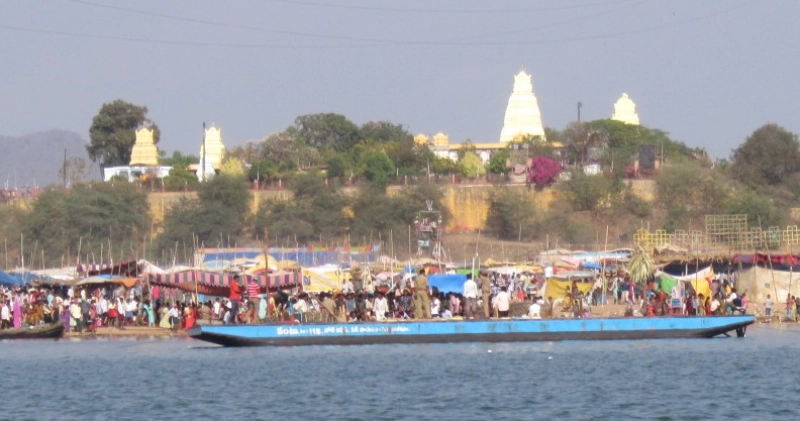
- Another Veerabhadra kshetra: devotees of Veerabhadra Swamy also revere the Sri Veerabhadra Swamy Temple, Pattiseema, on an island in the Godavari.
- Nearby temple: the Sri Khadri Lakshmi Narasimha Swamy Temple, Kadiri, in the same district.