Dwaraka Tirumala
Chinna Tirupati
Chinna Tirupati, Dwaraka Tirumala, Andhra Pradesh, India

 Nearby Airport: Gannavaram
 Nearby Railway Station: Bhimadole , Eluru
 Nearby Bus Station:
Dwaraka Tirumala
Nearby Bus Station:
Dwaraka Tirumala
Description:
Dwaraka Tirumala — Chinna Tirupati, the Jewel of Andhra Pradesh
Nestled atop the serene Seshachala Hill amid the verdant forests of Eluru District (formerly West Godavari District) in Andhra Pradesh, the Sri Venkateswara Swamy Temple at Dwaraka Tirumala is one of the most sacred Vaishnava shrines in South India. Lovingly called Chinna Tirupati (Little Tirupati) by devotees across Andhra Pradesh and Telangana, this ancient temple mirrors the rituals, sanctity, and spiritual power of the great Tirumala at Tirupati — drawing over 50 lakh (5 million) pilgrims every year to seek the blessings of Lord Venkateswara, the Lord of Kali Yuga.
The Presiding Deity — Sri Venkateswara Swamy
Lord Sri Venkateswara Swamy, an incarnation of Maha Vishnu and Kaliyuga Vaikunta Vasa (the Lord of Vaikunta for the Kali Age), presides here in standing posture (Sthanaka), holding the Shankha (conch) and Chakra (discus) in his upper arms, with the lower right hand in Varada Hasta (boon-granting gesture) and the lower left hand pointing toward his feet — guiding devotees to the path of Sharanagati (surrender).
What makes Dwaraka Tirumala extraordinary is a feature virtually unique among all Venkateswara temples in the world: two idols of Lord Venkateswara are enshrined under a single Vimana Sikharam (sanctum tower).
- The Swayambhu Idol (Self-Manifested): The original idol, self-manifested from within an anthill (valmikam), with only the upper portion — from the chest upward — visible. The lower half remains within the sacred valmikam. The holy feet are believed to descend to Patala Loka, where Bali Chakravarthi worships them eternally. This Swayambhu idol represents Moksha (liberation). Abhishekam is never performed on this idol, as it would disturb the ants dwelling in the sacred valmikam — a unique distinction from Tirumala Tirupati.
- The Pratishthita Idol (Installed): A complete, full-form statue of Lord Venkateswara installed behind the Swayambhu idol by Srimad Ramanujacharya, consecrated per the Vaikhanasa Agama Sastra. All elaborate ritual worship — including Abhishekam, Pada Puja, garland offerings, and grand sevas — is performed on this installed idol. This idol represents Dharma, Artha, and Kama (the three worldly purusharthas).
Another distinction that sets Dwaraka Tirumala apart from every other major Venkateswara temple: the Lord here faces South. In virtually all other Venkateswara temples — including the great Tirumala at Tirupati — the deity faces east. Here, Lord Venkateswara faces south toward his devotee Sage Dwaraka, who performed penance facing north. The main Rajagopuram (entrance tower) therefore also faces south.
The divine consort Goddess Padmavathi Devi, along with Nanchari Ammavaru, is enshrined in the Ardhamandapa (inner hall), facing east — bringing the grace of both Lord and Goddess within a single sacred precincts.
The Sacred Legend — Sage Dwaraka and the Swayambhu
The temple takes its name from Sage Dwaraka Maharshi, a great rishi who performed intense tapasya (penance) in the dense forests of this hill, praying for a vision of Lord Vishnu. As his penance deepened over the years, an anthill grew around him, covering his body. Moved by his absolute devotion, Lord Venkateswara self-manifested (Swayambhu) from within the anthill — facing south toward his worshipper. The sage unearthed the upper portion of the divine idol and began his worship. Since the lower half remained within the valmikam, full ritual Pada Puja (worship of the feet) was impossible. When the great Vaishnava philosopher saint Srimad Ramanujacharya visited this sacred site, he brought a complete idol from Tirumala (Tirupati) and installed it in the same sanctum following Vaikhanasa Agama protocols — enabling the full range of ritual worship that devotees experience today.
The hill itself is called Seshachala — the Hill of Shesha (the divine serpent Ananta). According to local tradition, the hill is shaped like a giant serpent, and Ananta Deva himself took this form, carrying Lord Mallikarjuna (Shiva) on his hood and Lord Venkateswara on his tail. This is why a Mallikarjuna Shiva temple stands on the adjacent hillock — the two great traditions of Shaivism and Vaishnavism coexisting harmoniously on a single sacred hill.
The antiquity of this shrine is documented in the Brahma Purana through the legend of King Aja Maharaja, grandfather of Lord Sri Rama in the solar Ikshvaku dynasty. While travelling to attend Princess Indumati's Swayamvaram (a royal bride-choosing ceremony), King Aja passed this hill without stopping to offer worship. Though he won the princess's garland, he was immediately engulfed in fierce battle with all the assembled kings. Recognising his disrespect toward Lord Venkateswara as the cause, Aja prayed sincerely — and the battle ceased miraculously. This legend, set in Treta Yuga, attests to the timeless sanctity of this shrine.
Architecture
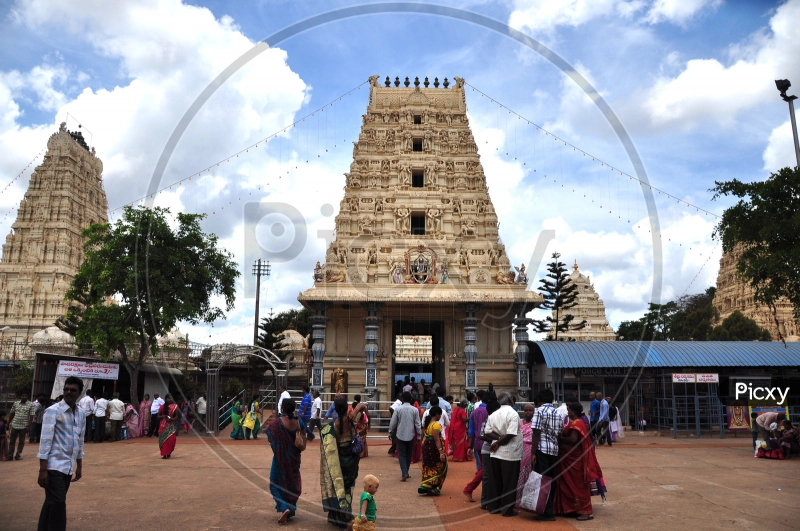
The temple complex is approached by 38 steps climbing the Seshachala Hill. The complex is marked by four gopurams facing all four cardinal directions, with the main five-storied Rajagopuram facing south — consistent with the south-facing deity within. The gopurams are richly adorned with sculptural work in Dravidian tradition.
The Vimana (tower over the inner sanctum) uniquely follows the Nagara architectural style (North Indian) while the outer prakara and gopurams are in Dravidian style — a harmonious architectural blend. The Mukhamandapa (main hall), Ardhamandapa, Natamandapa, and circumambulation path are all built of carved granite. The Saptarishis (seven sages) are depicted above the main doorway, and twelve Alwar saints' sculptures are positioned around the sanctum. At the entrance stand statues of Sage Dwaraka and the great composer-saint Tallapaka Annamacharya (15th century), who composed hundreds of immortal keertanas on Lord Venkateswara.
The temple's sacred tank is the Narasimha Sagar (also called Swamivari Pushkarini or Kumara Tirtha), with multiple bathing ghats including Chakra Tirtha and Snana Tirtha. The Kalyana Katta — the hair tonsure facility, with over 95 barbers — is located to the west of the main temple.
Rituals and Traditions
All rituals at Dwaraka Tirumala follow the Vaikhanasa Agama Sastra — the same sacred ritual code observed at Tirumala Tirupati. Key daily rituals include Suprabhatam (wake-up service at 4:00 AM), Sahasranama Archana, Balabogam, Sarva Darshan (free general viewing), Nityarjitha Kalyanam (daily celestial wedding ceremony), Maha Naivedyam, and the closing Ekanta Seva.
Hair tonsure (Mundana/Kesakhandana) is practiced extensively, with over 95 barbers serving thousands of devotees daily at the Kalyana Katta — just as at Tirumala, where devotees offer their hair as an act of ego-surrender and vow fulfilment.
A uniquely rare tradition is the celebration of two annual Brahmotsavams (grand 9–10-day festivals) — one for each idol:
- Vysakha Tiru Kalyanotsavam (April–May, Vaisakha Suddha Chaturdasi) — for the Swayambhu idol
- Aswayuja Tiru Kalyanotsavam (September–October, Aswayuja Suddha Chaturdasi) — for the Pratishthita idol
Both Brahmotsavams involve spectacular vahana sevas (processions on Garuda, Hanuman, Seshavahana, etc.), celestial wedding ceremonies, and massive devotional gatherings.
Other notable traditions include Giripradakshina (circumambulation of the hill) on Kanuma day (January), Vaikunta Dwara Darsanam on Dhanurmasa Ekadasi (December–January), and the beautiful Teppotsavam (boat festival) on Kartika Suddha Dwadasi (November), when the Lord is taken on a decorated boat across the Narasimha Sagar tank.
Visitor Information
- Location: Dwaraka Tirumala village, Dwaraka Tirumala Mandal, Eluru District, Andhra Pradesh — PIN 534 426
- Distance: ~42 km from Eluru | ~98–101 km from Vijayawada | ~72–75 km from Rajahmundry | ~370 km from Hyderabad
- Timings: 4:00 AM – 1:00 PM | 3:00 PM – 9:30 PM (daily, all year)
- Darshan: Free Sarva Darshan (general); Special/Antharalaya Darshan: ₹100–₹500; Online booking: aptemples.ap.gov.in
- Nearest railway: Bhimadole Railway Station (~15–18 km on Vijayawada–Visakhapatnam mainline); Eluru Junction (~42 km) for better connectivity
- Nearest airports: Rajahmundry Airport (Madhurapudi, RJA) ~75 km | Vijayawada Airport (Gannavaram, VGA) ~100 km
- Accommodation: Temple Devasthanam guest houses (aptemples.ap.gov.in); AP Tourism Haritha Hotel; private lodges in Dwaraka Tirumala village; Annadanam (free meals) available daily
- Administration: AP Government Endowments Department (not TTD); website: dwarakatirumala.org; Ph: +91-8829-271436
- Best time: October–March (pleasant weather); Brahmotsavam seasons (April–May and September–October) for the grandest celebrations; avoid mid-summer peak heat