Heritage · Faith · Tradition
About the Temple
Introduction
Sri Kaleshwara Mukteeswara Swamy Temple at Kaleshwaram, in Mahadevpur mandal of Jayashankar Bhupalpally district, Telangana, is one of the most sacred Shiva kshetras of the Telugu lands. It stands near the Triveni Sangamam – the meeting of the Godavari, the Pranahita and, by tradition, the hidden (antarvahini) Saraswati – and is revered as one of the three Trilinga Kshetras, together with Srisailam and Draksharamam. For its sanctity it is also called Dakshina Kashi – the Kashi of the South.
Two Lingas on One Pedestal
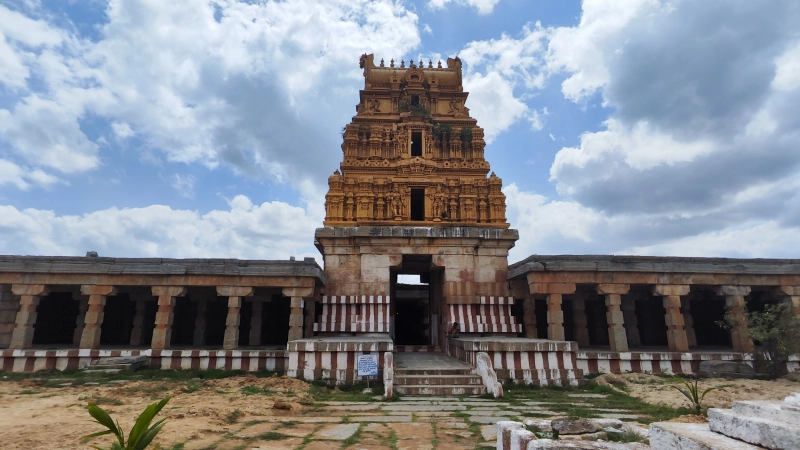
The unique glory of Kaleshwaram is that two lingas stand on a single pedestal (panavattam) in the sanctum: Mukteeswara, Lord Shiva, the giver of liberation, and Kaleshwara, associated with Yama (Kala), the lord of death and dharma. The temple is also known for having four entrances, with four Nandis, four flagstaffs (dhwajasthambhams) and four gopurams, one on each side.
Sthala Puranam (Legend)
According to tradition, Yama Dharmaraja performed intense penance before Lord Mukteeswara for twelve years. Pleased, the Lord appeared to him, and Yama asked to be given a place beside him and to be worshipped by the devotees first. The Lord granted his wish – and so the two lingas stand together, and the shrine came to be called Kaleshwara, joining the names of Kala and Ishwara. Devotees therefore worship Kaleshwara and then Mukteeswara, praying for freedom from the fear of death and for liberation.
Another tradition concerns the Mukteeswara linga itself, which has two small openings, often described as nostrils. It is believed that the water poured on it in abhishekam flows away through these openings by hidden passages to the river at the Sangamam, and that however much water is poured, it never overflows.
Triveni Sangamam
Below the temple, the Pranahita joins the Godavari, and tradition holds that the Saraswati flows in unseen beneath them. A holy bath at the Sangamam, followed by darshan of Kaleshwara and Mukteeswara, is the heart of the pilgrimage, and the village has several other sacred bathing places (tirthas). Families also perform rites for their ancestors on the river bank.
Pushkaralu at Kaleshwaram
- Godavari Pushkaralu: Kaleshwaram is one of the principal Telangana bathing places of the Godavari Pushkaralu, held once in twelve years when Jupiter enters Simha rasi.
- Pranahita Pushkaralu are also celebrated at the Sangamam in their turn.
- Saraswati Pushkaralu: because of the hidden Saraswati, Kaleshwaram also hosts the Saraswati Pushkaralu – the most recent was held in May 2025, when lakhs of devotees from Telangana, Andhra Pradesh, Maharashtra, Chhattisgarh and beyond bathed at the Triveni Sangamam.
Festivals
- Maha Shivaratri – special abhishekams and worship through the night.
- Karthika Masam – holy baths at the Sangamam and lamps for the Lord.
- Pushkaralu of the Godavari, the Pranahita and the Saraswati, in their twelve-year cycles.
Visitor Information
- Darshan: pilgrims usually bathe at the Sangamam first and then go for darshan of the two lingas.
- River safety: bathe only at the designated ghats; the currents at the confluence can be strong, especially in the monsoon.
- Crowds: Mondays, Maha Shivaratri, Karthika masam and the Pushkaralu draw very large crowds.
How to Reach
- By Road: Kaleshwaram is about 17 km from Mahadevpur and is connected by road with Manthani, Bhupalpally, Hanamkonda and Karimnagar; TGSRTC runs buses, with special services during the Pushkaralu.
- By Train: the nearest railway stations are Mancherial (about 70 km) and Ramagundam (about 80 km).
- By Air: the nearest airport is Rajiv Gandhi International Airport, Shamshabad (Hyderabad), about 260–280 km away by road.
Other Trilinga and Godavari Kshetras
The other two Trilinga Kshetras are Sri Bhramaramba Mallikarjuna Swamy, Srisailam and Sri Bhimeswara Swamy, Draksharamam. Along the Godavari, pilgrims also visit Basara upstream and Bhadrachalam downstream.