Heritage · Faith · Tradition
About the Temple
Introduction
The Thillai Nataraja Temple at Chidambaram, in Cuddalore district, Tamil Nadu, is one of the most sacred Shiva temples in India. Here Lord Shiva is worshipped as Sri Nataraja – the Lord of Dance – performing the Ananda Tandava, the cosmic dance of bliss. The temple is the Pancha Bhoota Sthalam of the sky (akasha) element, one of the five great shrines where Shiva is worshipped as the five elements, and for Shaivas the word "Koil" (the temple) on its own traditionally means Chidambaram.
Main Deity – Sri Nataraja
The presiding deity is the radiant image of Nataraja in the golden hall, the Chit Sabha (the hall of consciousness), together with Goddess Sivakami. The dance of Nataraja represents the five cosmic acts of the Lord – creation, preservation, dissolution, concealment and grace. The roof of the Chit Sabha is covered with gold tiles, and the hall is also called the Kanaka Sabha (golden hall).
Beside Nataraja is the Chidambara Rahasyam – "the secret of Chidambaram". Behind a curtain, there is no image at all, only a space adorned with a garland of golden bilva leaves. It represents Shiva as formless space – the sky element – and teaches that the Lord is present everywhere. Devotees also worship Shiva here in the form of a crystal Lingam and as the Ratna Sabhapathi.
Sthala Puranam (Legend)
According to tradition, Chidambaram was once a forest of thillai trees, where the sages Patanjali and Vyaghrapada prayed to see Lord Shiva's dance. Pleased with their devotion, Shiva performed the Ananda Tandava before them in this forest, and promised to dance here forever for the blessing of the world. The temple stands on the spot where this divine dance is believed to have taken place.
Govindaraja Perumal
Within the temple is also the shrine of Sri Govindaraja Perumal – Lord Vishnu reclining on Adisesha – which is one of the 108 Divya Desams. Seeing both Shiva and Vishnu from one place in the temple is considered especially auspicious.
Architecture
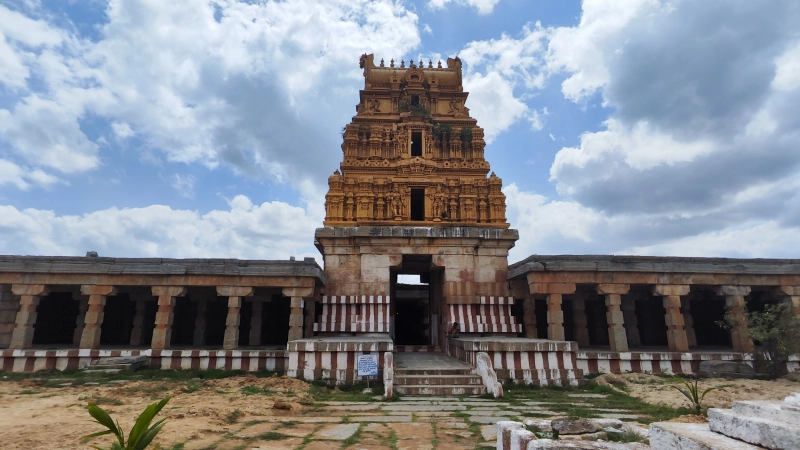
The temple is a great example of the South Indian Dravidian style, developed over many centuries with the support of the Chola kings and later rulers. It has four towering gopurams; the gateways are famous for their carvings of the 108 karanas – the poses of classical dance described in the Natya Shastra – making the temple a sacred place for dancers. Within the complex are the Chit Sabha, Kanaka Sabha, Nritta Sabha and Raja Sabha (the thousand-pillared hall), and the large sacred tank, Shivaganga.
Administration
The temple has traditionally been looked after by the Podhu Dikshitars, a hereditary community of priests who perform its worship according to their own Vedic tradition. In 2014, the Supreme Court of India upheld their role in the temple's administration.
Festivals
- Arudra Darshan (Margazhi, December–January): one of the two greatest festivals, celebrated on the Thiruvathirai star. After ten days of festivities and a grand chariot procession, Sri Nataraja gives the famous Arudra darshan to lakhs of devotees.
- Ani Thirumanjanam (Aani, June–July): the other great annual festival, with the sacred abhishekam of Nataraja and the chariot festival, when the Lord comes out of the sanctum to bless devotees.
- Natyanjali (around Maha Shivaratri, February–March): a classical dance festival where dancers from across India offer their art to Nataraja.
Temple Timings
- The temple is open in the morning and again in the evening, with six daily poojas.
- Arrangements change during Arudra Darshan and Ani Thirumanjanam. Please check locally before your visit.
How to Reach
By Train: Chidambaram railway station is close to the temple, on the Chennai–Thanjavur main line.
By Road: Chidambaram is about 230 km from Chennai and well connected with Cuddalore, Puducherry, Kumbakonam and Thanjavur. TNSTC buses run frequently.
By Air: the nearest major airport is Chennai International Airport (MAA), about 240 km away; Tiruchirappalli International Airport (TRZ) is about 170 km away.
Visitor Information
- Dress code: traditional dress is expected – dhoti for men, and saree or churidar for women.
- Allow time: visit the Chit Sabha for Nataraja's darshan and the Chidambara Rahasyam, the Govindaraja shrine, and the carved gopurams.
- Crowds: Arudra Darshan and Ani Thirumanjanam draw very large crowds.
- Nearby places: Thillai Kali Amman Temple, Pichavaram mangrove forest, the Airavatesvara Temple, Darasuram, the Sri Ranganathaswamy Temple, Srirangam (another Divya Desam), and – another of the Pancha Bhoota Sthalams, for the fire element – the Arulmigu Arunachaleswarar Temple, Tiruvannamalai.
- Pancha Bhoota pilgrimage: the Sri Kalahasteeswara Swamy Temple, Srikalahasti is the shrine of the air element (Vayu Lingam).