Heritage · Faith · Tradition
About the Temple
Introduction
The Sri Kalahasteeswara Swamy Temple at Srikalahasti, in Tirupati district of Andhra Pradesh, is one of the holiest Shiva temples of South India. It stands on the banks of the Swarnamukhi river, at the foot of hills, and is revered as the Vayu Sthalam – the shrine of the air element among the five Pancha Bhoota Sthalams, where Shiva is worshipped as earth, water, fire, air and space. Devotees also call it Dakshina Kailasam, the Kailasa of the South. Today it is equally famous across India for the Rahu-Ketu puja.
Main Deities
The presiding deity is Lord Shiva as Sri Kalahasteeswara, worshipped in the form of a self-manifested (Swayambhu) Vayu Lingam. As a mark of reverence, the priests do not touch the main Lingam with their hands. Devotees point to the lamp in the sanctum, whose flame is said to keep flickering as if moved by a breeze even though no air enters the closed chamber – a sign of the Lord's presence as the air element. The Goddess is worshipped as Sri Gnana Prasunambika Devi (Gnana Prasunamba), the Mother who grants wisdom, in her own shrine within the complex.
Sthala Puranam – Sri, Kala and Hasti
The name of the town and the temple comes from three devotees who worshipped Shiva here and attained liberation:
- Sri – the spider: it wove delicate webs over the Lingam to protect it from sun and rain.
- Kala – the serpent: it placed precious gems on the Lingam as its offering.
- Hasti – the elephant: it brought water in its trunk and leaves to bathe and decorate the Lingam.
Each worshipped in its own way, unaware of the others, and their sincere devotion so pleased Shiva that he blessed all three with moksha. Their forms are remembered on the Lingam itself, and the place came to be called Sri-Kala-Hasti.
Bhakta Kannappa
Srikalahasti is also the land of Kannappa, the tribal hunter whose love for Shiva knew no rules. He offered the Lord whatever he had – water carried in his mouth and meat from his hunt – and when he saw blood flowing from the eye of the Lingam, he gave his own eye without a moment's thought. As he prepared to give the second, Shiva appeared and stopped him. Kannappa is honoured as one of the 63 Nayanars, the great Shaiva saints, and a shrine to him stands on the hill near the temple. His story is loved across the Telugu and Tamil lands as the purest example of selfless devotion.
Rahu-Ketu Puja
The temple is renowned for the Rahu-Ketu Sarpa Dosha Nivarana Puja, performed by devotees seeking relief from the effects of Rahu and Ketu in their horoscopes and from Sarpa or Kala Sarpa dosha. The puja is conducted in batches through the day in special halls, with tickets of different categories available at the temple counters. Srikalahasti is also notable as one of the few temples that remain open during solar and lunar eclipses, when special worship is offered.
History and Architecture
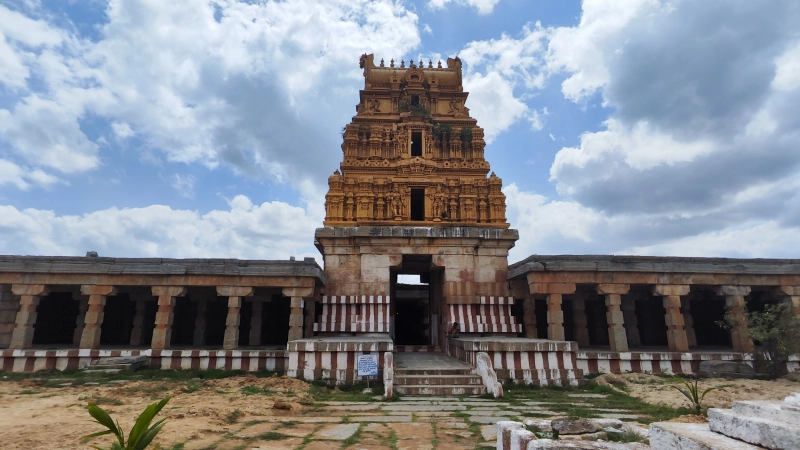
The shrine is ancient and is praised in the Tevaram hymns of the Shaiva saints, making it a Paadal Petra Sthalam. The temple grew over many centuries with the support of the Cholas and later the Vijayanagara kings; the great hundred-pillared mandapam and the tall gateway tower are linked with the time of Sri Krishnadevaraya. Built in the Dravidian style, the complex has massive stone walls, towering gopurams, long pillared corridors and finely carved halls set against the rocky hillside. The tall Rajagopuram, which fell in 2010, has since been rebuilt.
Festivals
- Maha Shivaratri Brahmotsavams (February–March): the grandest festival, held over many days with processions of the Lord and the Goddess on various vahanams and the celestial wedding.
- Karthika Masam (October–November): lamps, special abhishekams and large crowds, especially on Mondays.
- Eclipse days: special worship and Rahu-Ketu pujas while most other temples remain closed.
Temple Timings
- The temple is generally open from early morning until night, with Rahu-Ketu pujas held in batches through the day.
- Timings may change on festival and eclipse days; please check locally before your visit.
How to Reach
By Road: Srikalahasti is about 36 km from Tirupati and about 115 km from Chennai. APSRTC buses run frequently from Tirupati, Renigunta, Nellore and Chennai.
By Train: Srikalahasti railway station, on the Renigunta–Gudur line, is close to the temple. Renigunta Junction and Tirupati are major stations nearby.
By Air: the nearest airport is Tirupati Airport at Renigunta (TIR), about 25 km away. Chennai International Airport (MAA) is about 120 km away.
Visitor Information
- Dress code: traditional dress is recommended – dhoti or pyjama with an upper cloth for men, and saree or churidar with dupatta for women.
- Rahu-Ketu puja: buy tickets only at the official temple counters; the puja materials are provided by the temple.
- Best time to visit: October to February, when the weather is pleasant; weekends and eclipse days are very crowded.
- Pancha Bhoota pilgrimage: devotees often also visit the Arulmigu Arunachaleswarar Temple, Tiruvannamalai (fire element) and the Thillai Nataraja Temple, Chidambaram (space element).
- Nearby temples: Tirumala Sri Venkateswara Swamy Temple, the Sri Padmavathi Ammavari Temple, Tiruchanur, and the Sri Varasiddhi Vinayaka Swamy Temple, Kanipakam.