Heritage · Faith · Tradition
About the Temple
Introduction
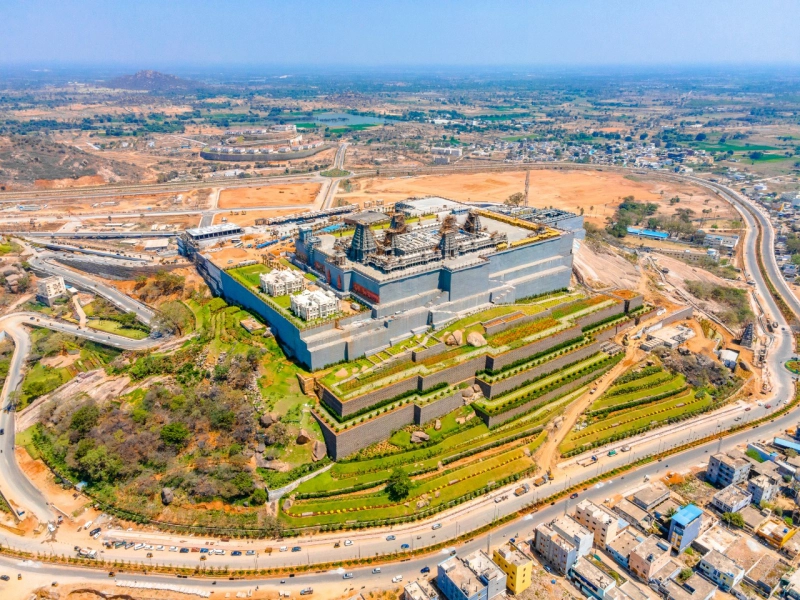
Sri Lakshmi Narasimha Swamy Devasthanam at Yadagirigutta, widely known as Yadadri, is the most famous Narasimha temple in Telangana and one of the holiest pilgrimage centres in the state. The temple crowns a hill in Yadadri Bhuvanagiri district, roughly 60 km east of Hyderabad, and receives devotees from across Telangana, Andhra Pradesh and beyond every day.
Main Deity and Worship
The Lord is worshipped as Sri Lakshmi Narasimha Swamy, the man-lion avatar of Lord Vishnu, together with Goddess Lakshmi. The deities are self-manifested (Swayambhu) and are seen inside a natural rock cave, which forms the heart of the sanctum. Within the hill, the Lord is revered in five forms – Jwala Narasimha, Yogananda Narasimha, Gandabherunda Narasimha, Ugra Narasimha and Lakshmi Narasimha – which is why Yadadri is honoured as a Pancha Narasimha Kshetram.
The hill also has a shrine for Lord Shiva as Sri Parvatha Vardhini Sametha Ramalingeswara Swamy, and Sri Anjaneya Swamy is worshipped as the guardian (kshetrapalaka) of the hill.
Sthala Puranam (Legend)
The hill takes its name from Yada Maharshi, a sage said to be the son of the great Rishi Rishyasringa. Tradition holds that Yada performed intense penance on this hill, longing for a vision of Lord Narasimha. Pleased with his devotion, the Lord appeared before him and, at the sage's request, agreed to remain on the hill in several forms to bless devotees for all time. The hill came to be called Yadagiri – "the hill of Yada" – and later Yadagirigutta and Yadadri.
Mahima / Significance
Narasimha at Yadadri is lovingly regarded as a healer. For generations, devotees suffering from long illnesses or troubles of the mind have stayed at the kshetram for a mandala (about 40 days), serving the Lord and praying for relief. Many families also come here to fulfil vows, for marriages, and to begin new ventures with the Lord's blessing.
On the day of Swathi nakshatram each month – the birth star of Lord Narasimha – devotees perform giri pradakshina, walking around the hill in devotion.
Architecture and Temple Complex
Between 2016 and 2022 the temple was completely rebuilt by the Government of Telangana on a grand scale. The new shrine is made almost entirely of black granite (Krishna shila), blending Dravidian temple design with Kakatiya-style carving. The rebuilding preserved the ancient cave sanctum while adding towering gopurams, richly carved pillared mandapams, wide prakarams and modern facilities for pilgrims. The renewed temple was consecrated with the Maha Kumbha Samprokshanam in March 2022.
Temple Timings
- The temple opens early in the morning with Suprabhatam and stays open until night, with short breaks for rituals and naivedyam.
- Timings change on festival days and during the Brahmotsavams. Please check the official Devasthanam website before your visit.
Darshan and Sevas
Free darshan is available every day, along with paid special-entry darshan. Popular sevas include Suprabhatam, abhishekam, archanas, Nitya Kalyanam and Sudarshana Narasimha Homam. Seva tickets and darshan slots can be booked through the official Devasthanam website. Prasadam, especially the famous laddu, is sold at the temple counters.
Festivals
- Annual Brahmotsavams (Phalguna, February–March): the grandest festival of the year, celebrated for about 11 days with vahana sevas, the divine wedding (Kalyanam) and the chariot festival (Rathotsavam).
- Narasimha Jayanti (Vaisakha, April–May): the appearance day of Lord Narasimha, celebrated over several days.
- Vaikuntha Ekadasi (December–January): devotees seek darshan through the Uttara Dwaram (northern gate).
- Swathi nakshatram (every month): giri pradakshina around the hill.
How to Reach
By Road: Yadagirigutta is about 60 km from Hyderabad via Ghatkesar and Bhongir. TGSRTC runs frequent buses from Hyderabad (including Jubilee Bus Station and Uppal), and taxis are easily available. Free shuttle buses take pilgrims from the foot of the hill to the temple.
By Train: The nearest station is Raigir (Yadadri), about 6 km away. Bhongir, about 13 km away, has more train services. Secunderabad is the nearest major junction.
By Air: The nearest airport is Rajiv Gandhi International Airport (HYD), Hyderabad, about 100 km away by road.
Visitor Information
- Dress code: traditional attire is expected – dhoti or kurta-pyjama for men, and saree or churidar with dupatta for women.
- Best time to visit: October to March, when the weather is pleasant. Weekday mornings are the least crowded.
- Crowds: weekends, public holidays, the Brahmotsavams and Narasimha Jayanti are very busy; allow extra time.
- Stay: Devasthanam cottages and private hotels are available at Yadagirigutta, with more options at Bhongir and Hyderabad.
- Nearby places: Bhongir Fort, Sri Lakshmi Narasimha Swamy Temple at Old Yadagirigutta (Purvagiri), and the Kolanupaka Jain temple.
