Heritage · Faith · Tradition
About the Temple
Introduction
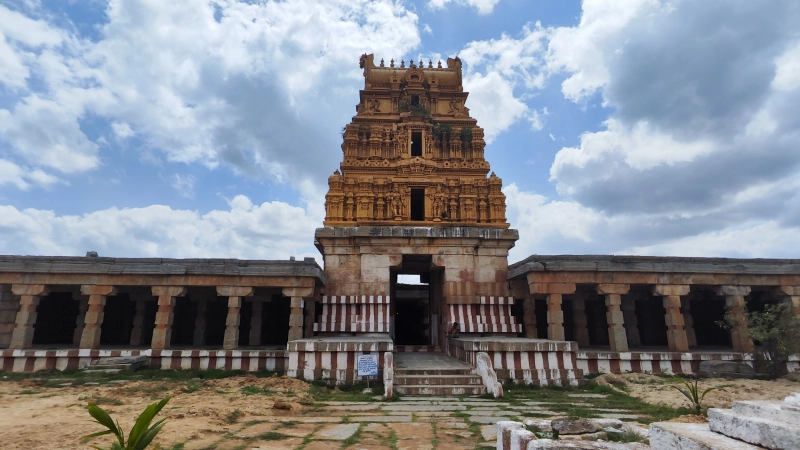
Sri Yaganti Uma Maheswara Swamy Temple lies in a quiet valley of the Erramala hills at Yaganti, about 14 km west of Banaganapalle in Nandyal district, Andhra Pradesh. Here Lord Shiva and Goddess Parvati are worshipped together as Uma Maheswara, carved in a single stone. Surrounded by red sandstone cliffs, natural caves and a spring-fed temple tank, Yaganti is one of the most loved Shiva kshetras of the Rayalaseema region, famous above all for its great Nandi, which devotees believe is slowly growing.
History
The present temple is traditionally attributed to the Sangama kings of the Vijayanagara Empire, with Harihara and Bukka Raya named as its builders, and it is usually dated to around the 14th–15th centuries. Local accounts say the site was sacred much earlier and that rulers of several dynasties contributed to it over the centuries. The towers, pillared halls and enclosure walls show the Vijayanagara style of temple building.
Sthala Puranam (Legend)
According to tradition, the sage Agastya came to this valley wishing to build a temple for Lord Venkateswara. But the idol he had prepared was found to have a broken toenail and could not be consecrated. Saddened, Agastya prayed to Lord Shiva, who appeared and told him that this place, which resembled Kailasa, was better suited to Shiva himself. At Agastya's request, Shiva agreed to dwell here together with Parvati as Uma Maheswara, in a single stone image, so that devotees could receive the blessings of both.
Another story explains the name of the place. A devotee named Chitteppa is said to have seen Lord Shiva in the form of a tiger and, overjoyed, cried out "Neganti Shivanu ne kanti" – "I have seen Shiva". Over time, tradition says, the place came to be called Yaganti.
The Growing Nandi
In front of the shrine sits a large monolithic Nandi (Basavanna), facing the Lord. Devotees believe this Nandi has been growing slowly over the years. Local accounts say that a pillar of the mandapa had to be removed to make room for it, and many attribute the change to the nature of the rock from which it is carved. It is also connected with the prophecies of Sri Pothuluri Veerabrahmendra Swamy, the 17th-century saint, who foretold that the stone Nandi of Yaganti would come alive and call out at the end of the Kali Yuga.
Agastya Pushkarini and the Absence of Crows
Beside the temple is the Agastya Pushkarini, a small tank fed by a spring that flows from the base of the hill through the mouth of a stone Nandi. The water is fresh and sweet and flows throughout the year; pilgrims bathe here before darshan. Tradition also says that crows disturbed Agastya's penance here and that he cursed them never to enter the place – and devotees note that crows are seldom seen around the temple.
The Sacred Caves
- Agastya Cave – reached by a steep climb of about 120 steps; the sage is believed to have performed his penance here, and a shrine of the Goddess is worshipped inside.
- Venkateswara Cave – holds the damaged idol of Lord Venkateswara linked with Agastya's story; the steps are steep.
- Veera Brahmam Cave – where Sri Veerabrahmendra Swamy is said to have stayed and meditated; the cave is low, so visitors must bend to enter.
Festivals
- Maha Shivaratri – the main festival, when devotees from across Andhra Pradesh gather for abhishekams, the Kalyanam of Uma Maheswara and night-long worship (usually February–March).
- Karthika Masam – lamps and special worship on Mondays of the month (usually October–November).
Visitor Information
- Timings: listed as about 6:00 am to 1:00 pm and 3:00 pm to 8:00 pm; please check locally on festival days.
- Time needed: allow two to three hours to see the temple, the Pushkarini and the caves.
- Caves: the cave steps are steep and uneven; elderly visitors and children should climb carefully.
- Photography: generally not permitted inside the shrine.
How to Reach
- By Road: Yaganti is about 14 km from Banaganapalle and about 75 km from Kurnool. APSRTC buses run from Banaganapalle, and taxis are available from Banaganapalle, Nandyal and Kurnool.
- By Train: the nearest major railway station is Nandyal Junction, about 50 km away; Kurnool City station is about 75 km away.
- By Air: the nearest airport is Kurnool Airport at Orvakal (KJB), about 60 km away by road; Rajiv Gandhi International Airport, Shamshabad (Hyderabad) is about 275 km away.
Nearby Places
Pilgrims often combine Yaganti with the Belum Caves (about 45 km) and the Shiva kshetras of the region, including Srisailam and Mahanandi. The Sri Raghavendra Swamy Mutt, Mantralayam is also in the Kurnool region, and another great Vijayanagara-era monolithic Nandi can be seen at Lepakshi.