Heritage · Faith · Tradition
About the Temple
Introduction
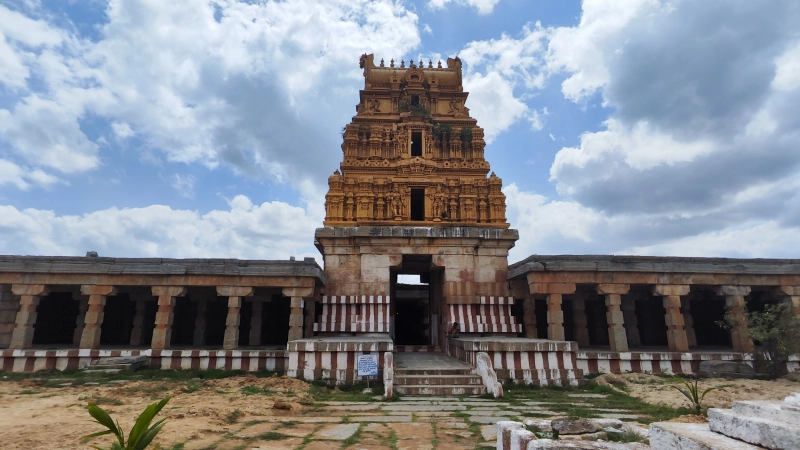
The Thousand Pillar Temple – also known as the Sri Rudreswara Swamy Temple – stands at the foot of the Hanumakonda hill in Hanamkonda, Telangana. Built by the Kakatiya dynasty in the 12th century, it is one of the finest monuments of Kakatiya art and architecture, and together with the Warangal Fort and the Ramappa Temple it forms the great heritage circuit of the Kakatiya capital region. The temple is protected by the Archaeological Survey of India and is still a place of active worship.
Main Deities – A Trikutalayam
The temple is a trikutalayam – a temple with three sanctums around a common hall. The three shrines are dedicated to:
- Lord Shiva as Sri Rudreswara – the main deity, from whom the temple takes its name;
- Lord Vishnu as Sri Vasudeva; and
- Lord Surya (the Sun) as Sri Suryeswara.
Bringing Shiva, Vishnu and Surya together in a single temple reflects the spirit of harmony between traditions that the Kakatiya kings promoted. In front of the temple sits a large, beautifully polished monolithic Nandi carved from black basalt, one of the most admired sculptures of the Kakatiya period.
History
According to the inscription in the temple, it was built by the Kakatiya king Rudradeva (also known as Prataparudra I) and dedicated to Rudreswara, Vasudeva and Suryeswara in Saka 1084, corresponding to 1163 CE. Rudradeva was one of the founders of Kakatiya power, and his inscription here is also an important record of the dynasty's early history. Hanumakonda was an early capital of the Kakatiyas, before the capital moved to nearby Warangal (Orugallu).
Architecture – The Thousand Pillars
The temple stands on a raised, star-shaped platform, and is famous for its many richly carved pillars – traditionally counted as a thousand – in the temple and in its large pillared hall (mandapam). The pillars are so arranged that worshippers can see the deities from many points in the hall. The black basalt surfaces are carved with great skill, with fine jewellery-like detailing, perforated stone screens, elephants, dancers and floral designs – hallmarks of the Kakatiya style, which developed from the traditions of the Kalyani Chalukyas.
In modern times, the large pillared mandapam, which had been damaged over the centuries, was carefully dismantled and restored by the Archaeological Survey of India, using traditional methods to rebuild it stone by stone.
Festivals
- Maha Shivaratri (February–March): the main festival, with special worship of Sri Rudreswara Swamy and large crowds.
- Karthika Masam (October–November): lamps are lit and special pujas are offered, especially on Mondays.
- Shravan month (July–August): Mondays draw many devotees for abhishekam.
Temple Timings
- The temple is generally open from early morning until evening.
- Timings change on festival days. Please check locally before your visit.
How to Reach
By Road: the temple is in Hanamkonda town, part of the Warangal urban area, about 145 km from Hyderabad. TGSRTC buses run frequently from Hyderabad and other towns to Hanamkonda bus station, and autos are easily available.
By Train: the nearest railway stations are Kazipet Junction and Warangal, both a few kilometres away, with trains on the Hyderabad–Vijayawada and Delhi–Chennai lines.
By Air: the nearest airport is Rajiv Gandhi International Airport (HYD), Hyderabad, about 150 km away.
Visitor Information
- Dress code: modest clothing is recommended.
- Heritage visit: take time to look closely at the carvings and the Nandi; a guide can help explain the details.
- Best time to visit: October to February, when the weather is pleasant.
- Kakatiya heritage circuit: combine your visit with the Warangal Fort and its famous Kakatiya Kala Thoranam gateways, the Bhadrakali Temple in Warangal, and the UNESCO World Heritage Ramappa Temple at Palampet.