
Heritage · Faith · Tradition
About the Temple
Introduction
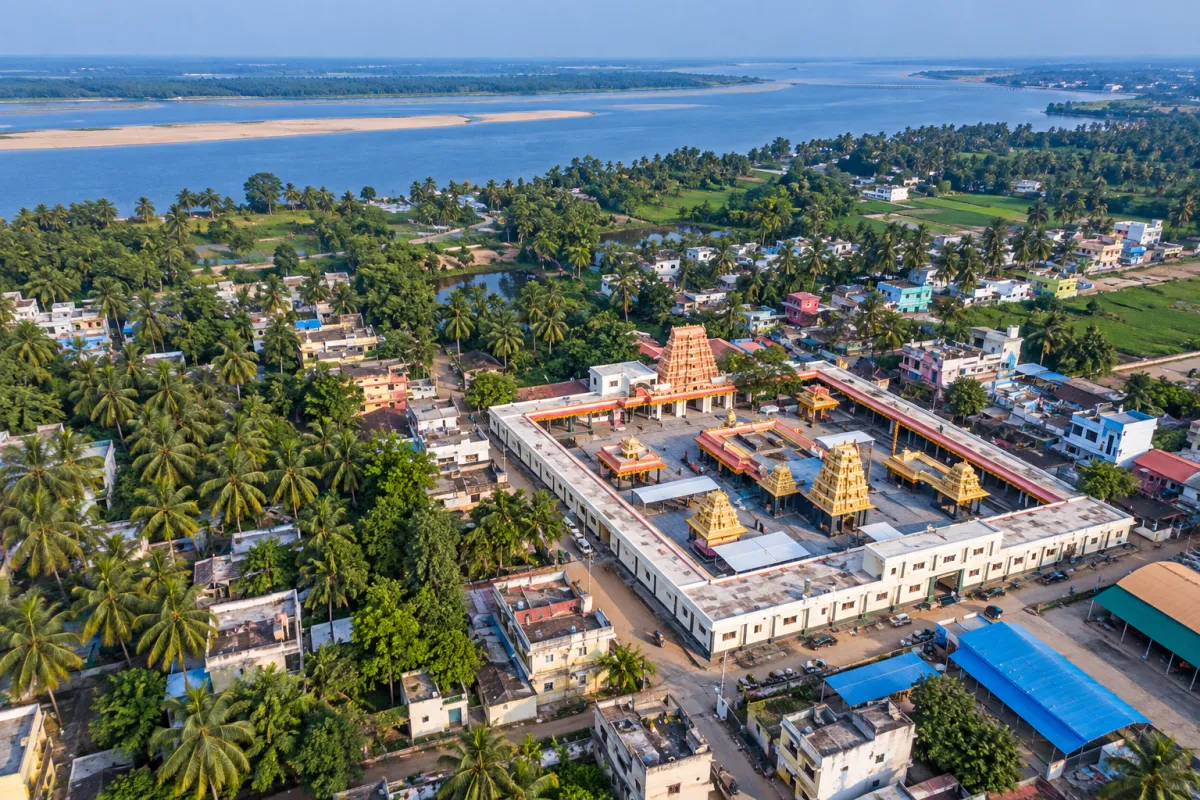
Vadapalli Sri Venkateswara Swamy Temple is a much-loved shrine of Lord Venkateswara in the village of Vadapalli, Atreyapuram mandal, Dr. B.R. Ambedkar Konaseema district (formerly East Godavari), Andhra Pradesh. It stands on the banks of the Gautami branch of the sacred Godavari, amid the green coconut groves of Konaseema. Devotees fondly call it "Konaseema Tirupati" or "Konaseema Tirumala", and the Lord here is lovingly known as Vadapalli Venkanna and Yedu Shanivarala Venkanna, the Lord of Seven Saturdays. The temple is administered by the Andhra Pradesh Endowments Department and, as Wikipedia notes, draws lakhs of devotees every year from different states of India, with especially large crowds every Saturday.
Main Deity and Worship
The presiding deity is Lord Sri Venkateswara, also worshipped here as Sri Kalyana Venkateswara Swamy. A distinctive feature of this kshetra is that the main idol (moola virat) is not carved from stone but from red sandalwood (Erra Chandanam) wood. Within the temple, Sri Venugopala Swamy is worshipped to the right of the Lord, Goddess Alivelu Manga Thayar on the northern side, Sri Ramanujacharya in the south-east, and Sri Visweswara Swamy with Goddess Annapurna on the southern side. The ceiling around the circumambulation path is inscribed with the Lord's Govinda Namalu, so that devotees can chant His names while they walk.
Sthala Puranam (Legend)
According to local tradition, the sages led by Sanaka and Sanandana once approached Lord Narayana in Vaikuntha, grieved at the growth of sin on earth. The Lord assured them that in Kali Yuga He would arrive, together with Goddess Lakshmi, in a sandalwood chest carried by the holy waters of the Gautami, at a place called Naukapuri, the old name of Vadapalli.
Tradition holds that the villagers saw a sandalwood log floating in the river, but it vanished whenever they tried to bring it ashore. The Lord then appeared in the dream of an elderly Brahmin. He told him that if the villagers bathed in the Gautami before dawn and went into the river by boat with auspicious music, they would find Him where a Krishna Garuda bird was perched. When they did so, they found in the sandalwood chest an idol of the Lord bearing the conch, discus and mace. A temple was raised on the river bank. Another version of the tradition says that the wooden idol drifted down the Godavari from Nasik Trimbakeshwar and that Sage Narada installed it and named the Lord Venkateswara.
History
Temple tradition recounts that an earlier shrine was swallowed by a great Godavari flood. Later, a landlord and boat-owner named Pinapotu (Pinubothu) Gajendrudu vowed to recover the Lord from the river and build Him a temple if his boats, lost in a storm, were restored to him. When the boats miraculously returned, he built the present temple and endowed it with land and ornaments. According to temple tradition, Raja Sri Vatsavai Pemma Gajapati Maharaju of the Peddapuram Samsthanam later granted 270 acres of land in 1759 so that the Lord's daily worship could continue without hardship.
The temple also has a place in the freedom struggle. During the Rathotsavam of 30 March 1931, local people refused to draw the chariot after the Sub-Inspector of Razole removed the portraits of national leaders from it. As recorded by the Ministry of Culture, a riot followed at Chinnavadapalli and ended in police firing on the crowd. In recent years the Devasthanam has expanded its facilities. In August 2026 the Vakulamatha Annadana building, built at a cost of ₹6.25 crore, was inaugurated (Deccan Chronicle).
Mahima / Significance
Vadapalli is famed for the Seven Saturdays vow (Yedu Shanivarala Vratam). Devotees believe that visiting the Lord on seven consecutive Saturdays and performing pradakshinas around the temple (commonly 7 or 11 rounds, according to one's vow) removes difficulties and fulfils sincere wishes. Many devotees also offer an abhishekam in the eighth week. For this reason, every Saturday sees thousands of pilgrims from the Godavari districts and beyond, with fair stalls lining the approach to the temple. Because the Lord is worshipped as Kalyana Venkateswara, devotees also pray here for marriage and family welfare.
Architecture and Temple Complex
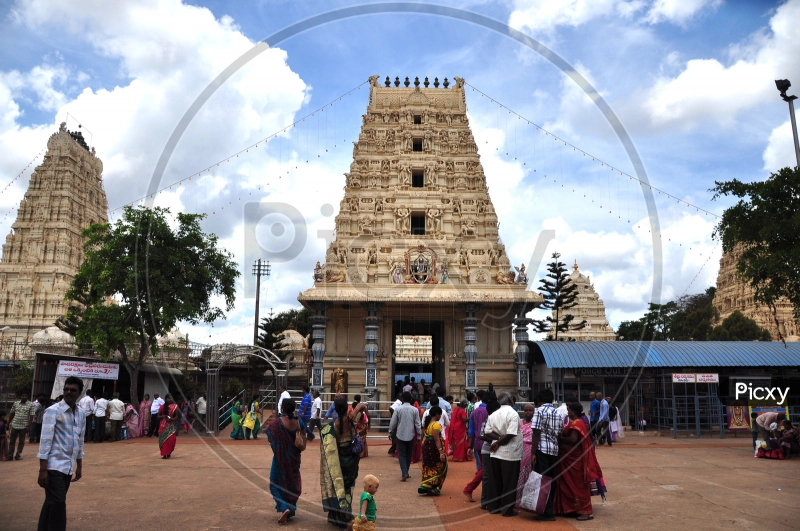
The temple complex stands on spacious grounds by the Godavari. Covered circumambulation paths inscribed with Govinda Namalu surround the sanctum, and there are separate shrines for the Goddess and the associated deities. According to Deccan Chronicle, the Devasthanam's new Vakulamatha Annadana building, inaugurated in August 2026, "can accommodate around 2,000 to 2,500 devotees at a time and has modern cooking equipment".
Temple Timings
- Sunday to Friday: generally about 6:00 AM to 1:00 PM and 4:00 PM to 8:00 PM
- Saturday: the temple opens early, from about 4:00 AM, and stays open until afternoon; it reopens in the evening until about 8:00–9:00 PM
- Timings change on festival days and during Brahmotsavams; please check with the Devasthanam before your visit
Darshan and Sevas
Free general darshan is available on all days, and paid special darshan tickets are also offered; a Visishta Darshan ticket is reported to be available on Saturdays. Sevas generally performed include Suprabhata Seva, Ashtottara Puja, Sahasranama Archana, Nitya Kalyanotsavam, Godadevi Kalyanam, Tulabharam, tonsuring (kesa khandana) and vehicle puja. Nitya Kalyanotsavam and Ashtottara Puja are reportedly not performed on Saturdays because of the crowds. Seva fees are revised from time to time, and some sevas can be booked online through the AP Endowments temple portal, so please confirm current details before booking. The Devasthanam serves free annaprasadam (annadanam) to devotees. The AP Endowments temple page notes that "every saturday Annadanam is performed by Temple management".
Festivals
- Annual Kalyanotsavam and Theertham (Chaitra, March–April): the Lord's celestial wedding, celebrated over about seven days with Dhwajarohanam, Rathotsavam, Kalyanam, Teppotsavam and Chakra Snanam. In 2026 it was held from 28 March to 3 April.
- Annual Brahmotsavams (Aswayuja, around October): nine days of vahana sevas on Hamsa, Hanumantha, Simha, Garuda, Chandraprabha, Suryaprabha, Gaja and Ashwa vahanams. The 13th annual Brahmotsavams were held from 10 to 18 October 2025.
- Vaikuntha Ekadasi: observed with heavy devotee rush and special darshan.
- Saturdays: every Saturday is a festival-like day, with large crowds observing the seven-week vow.
How to Reach
By Road: Vadapalli is about 10–11 km from Ravulapalem via Lolla, and Ravulapalem is well connected by road to all major towns. APSRTC buses run to Vadapalli from Rajamahendravaram bus station and from the Kotipalli, Gokavaram and Bobbarlanka bus stands in Rajahmundry, with extra services on Saturdays. Autos are available locally.
By Train: The nearest major railway station is Rajahmundry, about 27 km away. Nidadavolu Junction (about 30 km) is another option. Buses and taxis are available from Rajahmundry to the temple.
By Air: The nearest airport is Rajahmundry Airport (RJA) at Madhurapudi, about 50 km from the temple, with domestic flights to cities such as Hyderabad, Chennai and Bengaluru.
Visitor Information
- Dress code: traditional attire is recommended, such as dhoti or kurta-pyjama for men and saree, half-saree or churidar with dupatta for women; traditional dress is expected for sevas.
- Best time to visit: weekday mornings for a quieter darshan; Saturdays and festival days for the full devotional atmosphere, with long queues.
- Crowds: Saturdays, the Chaitra Kalyanotsavam, the Aswayuja Brahmotsavams and Vaikuntha Ekadasi draw very heavy crowds; arrive early.
- Stay: accommodation is available at Ravulapalem, Amalapuram and Rajahmundry.
- Nearby places: Sri Jaganmohini Kesava Swamy Temple and Sri Uma Kamandaleswara Swamy Temple at Ryali (about 5 km), known for the unique Vishnu–Mohini idol; the Godavari ghats and temples of Rajahmundry.
- Antarvedi: extend your Konaseema pilgrimage to the Sri Lakshmi Narasimha Swamy Temple, Antarvedi, where the Vasishta Godavari meets the sea.